
Yes, you can sell print on demand on Etsy, and plenty of small shops do. There's one condition: the design has to be yours, or the buyer has to customize it.
Say you draw a cartoon frog and upload it to a print company. You list a frog shirt on Etsy, and a buyer orders it. The order passes automatically to Printify, Printful or Gelato. They print the shirt and ship it in a plain package with no supplier branding. You keep what's left after Etsy and the printer take their share.
How print on demand works on Etsy
Three parties are involved, and each does a different job.
- Etsy is the marketplace. It brings the buyers, takes the payment and charges you fees.
- Your print partner makes the product and ships it. It charges you a base price plus shipping for every order.
- You design the products, write the listings, set the prices and handle customer service.
New sellers often miss that last point. The buyer has no idea Printify exists. If a shirt arrives late, in the wrong size or with a smudged print, the message comes to you. You'll often get a reprint from your supplier if they made the mistake, but sorting it out with the buyer is your job.
You never touch inventory, and you only pay for a shirt after someone has paid you for it. That's the big draw. What you give up is control. You can't check each item before it ships, and you depend on someone else's print quality and speed.
Is print on demand allowed on Etsy?
It is, as long as you stay on the right side of one line. Etsy's rules separate selling your own designs from reselling other people's products.
What counts as your own design
When you create a listing, Etsy asks who made the item. The choices come from its Creativity Standards: made by you, designed by you, handpicked by you (vintage items, for example) or sourced by you (such as craft supplies). A POD seller picks "Designed by". You came up with the artwork, and a partner turned it into a physical product.
The design has to be original. Something the buyer personalizes also qualifies, such as a mug printed with their dog's name or a family reunion shirt. Licensed artwork is a gray area. Unless the license clearly allows merchandise and Etsy's own rules accept it, stick to your own work while you're starting out.
Why this isn't dropshipping
Etsy bans dropshipping and reselling, which is why you've probably seen "Etsy POD is dead" posts. The ban doesn't cover POD done properly.
Etsy allows production partners. These are companies that physically make items from your original designs from start to finish. A print service fits that description. White-label makers, OEM and ODM factories, wholesalers and retailers don't. If you use them, Etsy treats it as reselling, and that can get listings pulled or your shop suspended.
Two examples:
- Allowed: your hand-drawn frog printed on a mug by Printify, listed as "Designed by" you, with Printify disclosed as your production partner.
- Not allowed: a generic phone case from a supplier catalog, listed under your shop name with no design of your own.
Your work has to be the thing that makes the product exist. If you could swap your shop name for someone else's and nothing about the product would change, it doesn't qualify.
Disclosing AI-generated designs
Etsy's rule is direct: seller-prompted AI creations must disclose the use of AI. If you made the artwork with an image generator, say so. Mark it in the listing's creation details and mention it in the description, so a buyer reading the listing can see it. AI artwork still has to clear the same originality and trademark rules as anything else. "The AI made it" won't help if the picture looks like a famous character.
Which print-on-demand companies connect to Etsy
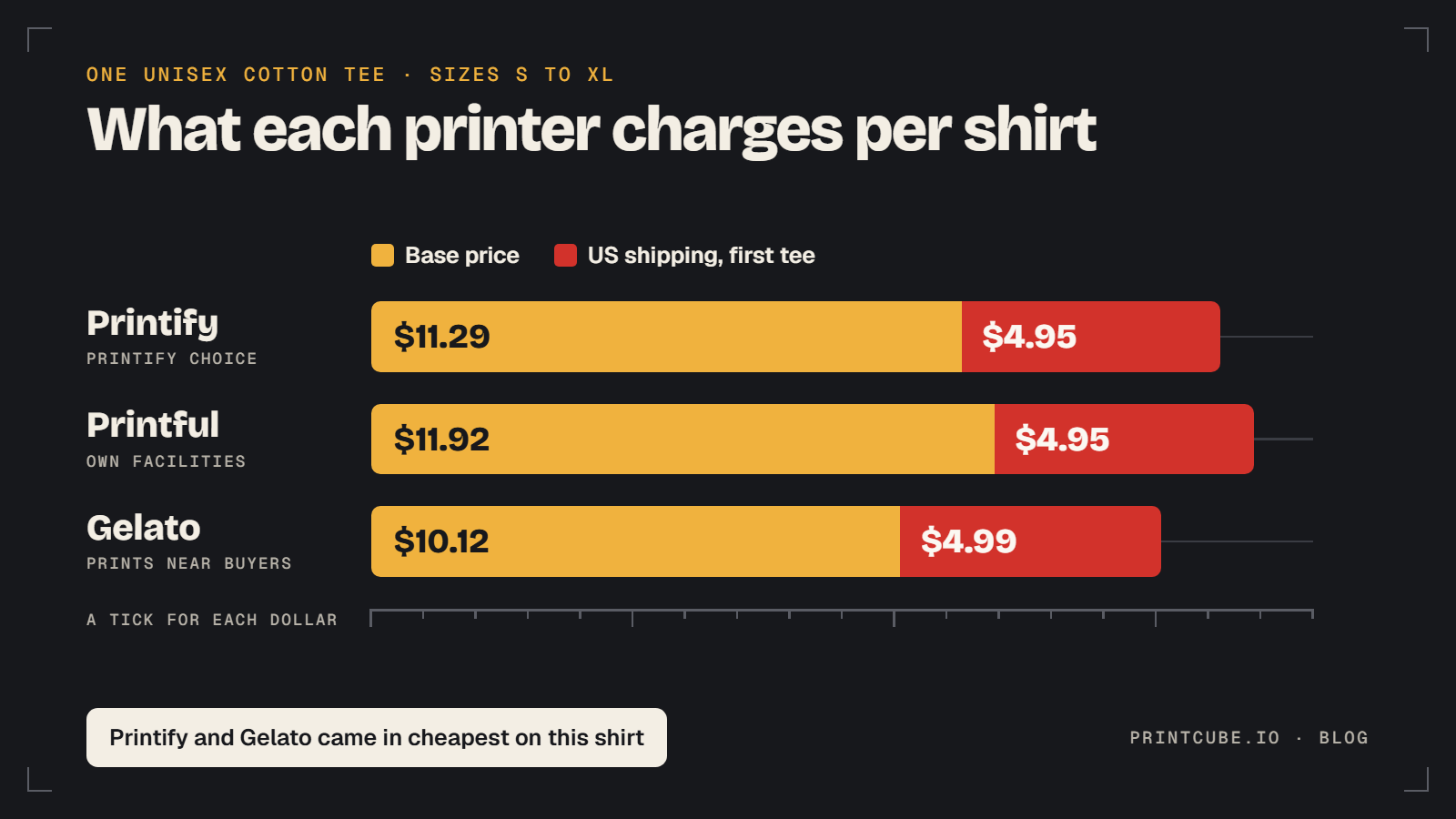
Most beginners pick one of three companies: Printify, Printful or Gelato. All three plug straight into Etsy and cost nothing to connect. The difference shows up in what you pay per order.
The prices below are for the Bella+Canvas 3001, a standard unisex cotton tee, in sizes S to XL, as each company listed them in October 2026. Base prices move with size, color and print provider, so check the current numbers on Printify's pricing page and Printful's pricing page before you set your prices.
| Printify | Printful | Gelato | |
|---|---|---|---|
| Cost to connect to Etsy | Free | Free | Free |
| Optional paid plan | Premium, $39 a month or $24.99 a month billed yearly, up to 20% off most products | Growth, $24.99 a month, up to 33% off products | Gelato+, $29.99 a month or $19.99 a month billed yearly |
| Base price, unisex tee | $11.29 with Printify Choice; named providers $11.43 to $14.98 | $11.92 | $10.12 |
| US shipping, first tee | $4.95 | $4.95 | $4.99 |
| Where it's strongest | Low prices and lots of print providers to choose from | Consistent quality, branding extras like custom labels | Local printing in many countries, good for international buyers |
Printify gives you the most print providers to choose from, and quality and speed vary between them. Pick a provider with strong ratings and a US location, then order a sample from them.
Printful makes most products in its own facilities, so quality is more predictable. You pay a little more per shirt for that: $11.92, against $11.29 for Printify Choice. It's a good option if you'd like to spend less time checking providers and are happy to price a little higher.
Gelato prints close to the buyer in a lot of countries. That helps if you're selling to the UK, Europe or Australia and don't want long international shipping times.
For a first shop, I'd go with Printify or Gelato. On Etsy, every dollar of base cost comes straight out of a thin margin, and on this shirt they were the two cheapest. With Printify, spend an hour comparing providers, and with either one, order a sample before you list anything. If the sample disappoints you, try Printful next.
Setting up your Etsy print on demand shop
You can usually get from no shop to your first published listing in an afternoon. Getting each listing set up correctly takes a bit longer than that.
Opening the shop
Etsy charges a one-time, non-refundable fee to open a shop. The amount depends on your country, and Etsy shows it before you pay. You'll also need:
- A shop name. Pick one that fits your niche and still works if you add more designs later.
- Bank details for payouts, plus identity verification.
- A filled-in About section.
Don't skip the About section. Etsy expects you to explain how your items are made, and a sentence like "I create the designs, and my printing partner produces and ships each order" covers part of your production partner disclosure.
Adding your production partner
Do this before your first sale.
- Go to Shop Manager > Settings > Partners you work with. You can also add a partner while you're creating or editing a listing.
- Add your print company and fill in the public About production partner field. Keep it plain, for example: "Printify, a print service that prints and ships my original designs."
- Attach that partner to every listing it produces. One listing without it is a rule break.
- Make sure your shipping profile shows where orders ship from, which is your partner's location and not your home address.
If you use two print companies, add both and attach the right one to each listing.
Connecting Printify or Printful
The connection is made from the supplier's side. Printify and Printful work much the same way:
- Create a free account with the print company.
- Choose Etsy as your sales channel or store.
- Sign in to Etsy when asked and authorize the connection.
- Pick a product, upload your design and set up the mockups, variants and price.
- Publish it. The listing appears in your Etsy shop.
Button names change from time to time. If something doesn't match, the supplier's help center has the current steps.
Once the first listing has synced, open it in Etsy and check four things:
- The production partner is attached. Some syncs don't add it.
- "Designed by" is selected, not "Made by".
- Shipping profile and processing time are realistic. Add your partner's production time to the shipping time. If that comes to 7 to 10 days, don't promise 3.
- Mockups match what will print. Check color, placement and print size. A mockup that makes the design look bigger or brighter than the real product leads to returns.
Your first listings
Choose one narrow niche and aim for 10 to 20 listings in it. "Frog shirts for gardeners" will do better than one design on 15 random products. A focused shop is easier for buyers to find and easier for you to build on.
Products that work well as starting points:
- T-shirts and sweatshirts
- Posters and wall art
- Mugs
- Tote bags
- Stationery like notebooks and stickers
Use mockups that look like real photos: a shirt on a person, a mug on a kitchen counter. Write titles and tags around the words buyers search for. A keyword tool like eRank shows what people type and how much competition you'd be up against.
Base your prices on the math in the next section, not on what other shops charge.
What Etsy charges on a typical POD sale
Let's say you sell your frog shirt for $26 plus $5 shipping. The buyer pays $31.
Here's what Etsy takes:
- Listing fee: $0.20. It renews every 4 months, and each extra unit in the same order costs another $0.20.
- Transaction fee: 6.5% of the order total, shipping included. That's about $2.02.
- Payment processing (US): 3% + $0.25, so about $1.18.
That's about $3.40 to Etsy.
Your print partner then charges for the shirt. With Printify Choice, the base price plus first-item shipping comes to $16.24 ($11.29 + $4.95).
$31.00 − $3.40 − $16.24 leaves you about $11.36, a little over a third of what the buyer paid.
That's a decent amount for a shirt you never touched, but there isn't much room to play with. Two common changes show how fast it shrinks:
- Drop the price to $23 + $5 shipping. Etsy's cut falls to about $3.11, and you keep around $8.65.
- Offer free shipping at $26. You still pay the printer's shipping, Etsy's fees drop to about $2.92, and you're left with around $6.84.
A $3 discount looks small to the buyer, but it costs you about a quarter of your profit.
The processing fee is worked out on the full amount the buyer pays, including any sales tax Etsy collects. On a taxed order, it's a few cents higher than in the example. The transaction fee doesn't apply to tax.
When the sale comes through Offsite Ads
Etsy advertises some listings on Google, social media and other sites. If a buyer clicks one of those ads and buys within 30 days, you pay an Offsite Ads fee. It's 15% of the order total for shops under $10,000 in sales over the past 365 days, and 12% above that, capped at $100 per order.
On the frog shirt, that's another $4.65, which brings you down to about $6.71. Under $10,000 in sales, you can opt out in your settings. Once you pass $10,000, Offsite Ads becomes mandatory. Set your prices so a sale through Offsite Ads still makes you money, because it will happen on some of your orders.
Selling outside the US
The processing fee depends on where your bank account is:
- UK: 4% + £0.20
- Canada: 3% + C$0.25 for domestic and US orders, 4% + C$0.25 for other international orders
- Most EU countries: 4% + €0.30
If your listing currency differs from your payout currency, Etsy adds a 2.5% conversion fee. Some countries also have a small regulatory operating fee on each order. Check Etsy's fee page for your country when you work out your prices.
Mistakes that cost new Etsy POD sellers
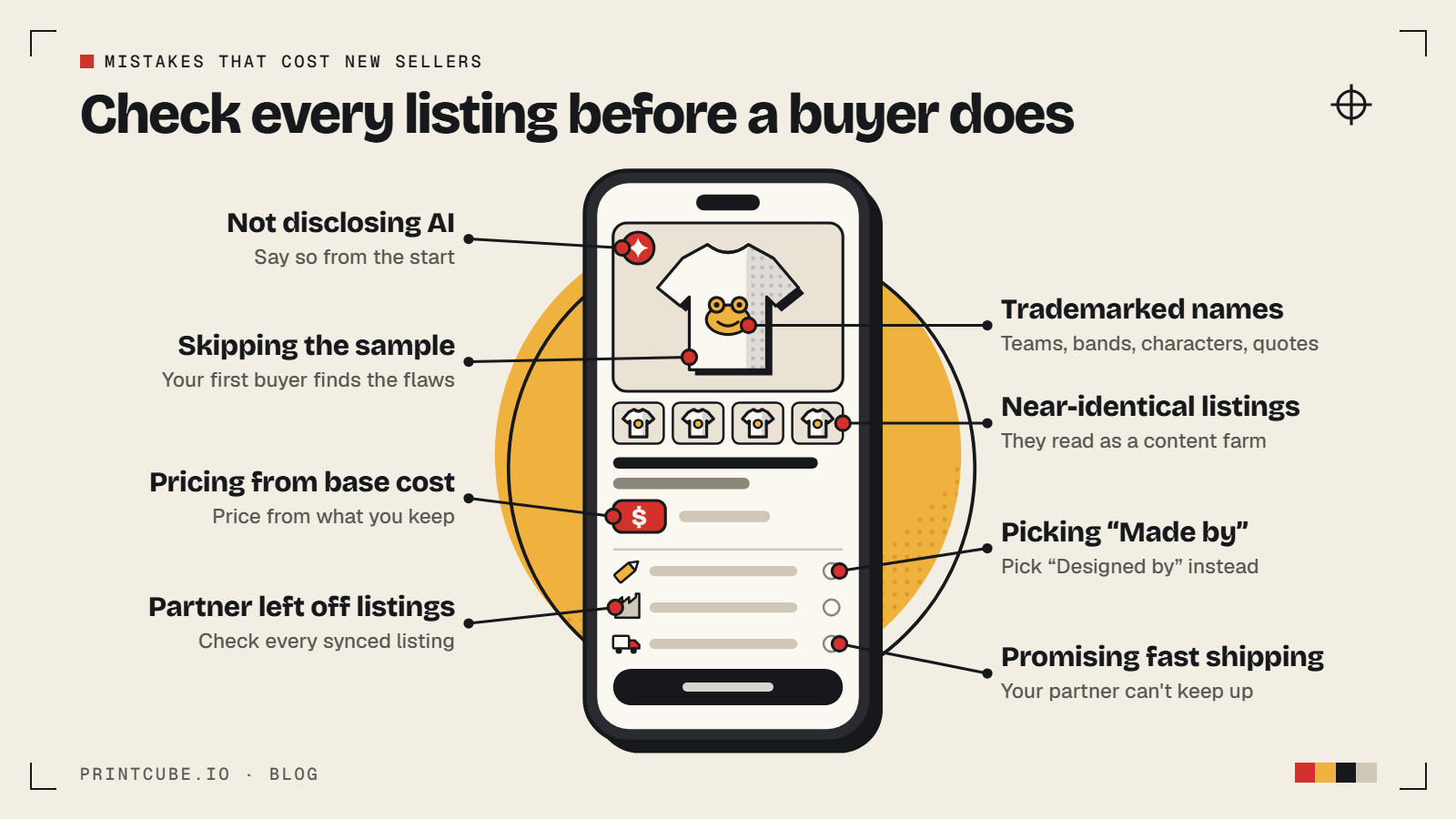
Most of these won't cause a problem the day you make them. They tend to show up a few weeks later, as a listing takedown, a bad review or a sale that made no money.
Using trademarked names, characters or teams
Sports teams, band names, cartoon characters, movie quotes and phrases someone has trademarked are the fastest way to get listings removed. Enough strikes and Etsy suspends the shop. "Fan art" doesn't make it okay. Do a quick trademark search on any phrase that feels familiar before you use it.
Leaving the production partner off some listings
Disclosure has to be on every listing your partner makes. New listings published from Printify or Printful can sync without it, so check each one.
Picking "Made by" instead of "Designed by"
You didn't print the shirt, so "Made by" misrepresents how it was produced. Getting this wrong across your shop looks like a policy problem, not a typo.
Pricing from the base cost
Charging $18 for a shirt that costs you $16.24 to make looks profitable until Etsy takes its fees. Price from what you'll keep after Etsy, the printer and a possible Offsite Ads fee.
Promising shipping your partner can't meet
If your processing time says 2 days and the printer needs 5, every order ships late. Late orders bring bad reviews, and they also count against Star Seller status, which affects how buyers see your shop.
Skipping the sample order
A sample costs you a few dollars and shows you the colors, the print size, how the fabric feels, and whether the design survives a wash. Without one, you find these things out from your first unhappy buyer.
Flooding the shop with near-identical listings
Fifty versions of the same quote in different fonts across random niches make your shop look like a content farm. Buyers move on, and Etsy's search doesn't reward it either.
Not disclosing AI
If you made a design with AI and didn't say so, you've broken a rule that's easy to follow. Disclose it from the start.
Is Etsy print on demand worth it for you?
It's worth it if you have your own design ideas and you'd like buyers to find you without building traffic from scratch. Etsy has tens of millions of active buyers searching for the kind of thing you make, and you'd struggle to bring that many people to a standalone store on your own. In return, you accept small margins and fees on every order.
It's a weaker fit if you're hoping to upload generic designs in bulk and let volume do the work. Etsy's rules, the competition from other sellers and the per-sale margin all work against that approach.
Expect a slow start. Many new shops go weeks without a sale while listings get indexed and pick up their first views. What usually helps is adding to one niche, reading which listings get views and favorites, and improving titles, photos and designs based on what you see. Nobody can tell you what you'll earn, and anyone who promises a figure is guessing.
My recommendation: if you have design ideas you're excited about, open the shop, connect Printify, order a sample, and publish 10 listings in one niche. You'll learn more from that first month than from more reading.
FAQ
Do I need to order samples before listing?
Etsy doesn't require it, but you should. A sample shows you color, print size and fabric quality before a buyer sees them. It also gives you real photos for your listings. Order one sample per product type and print provider.
Can I use the same design with Printify and Printful in one shop?
Yes. You can connect both to one Etsy shop, as long as each listing is synced from one of them. Add both as production partners and attach the correct one to each listing.
Who handles returns and damaged items, me or the print company?
You deal with the buyer. If the printer made the mistake, such as a misprint, damage in transit or the wrong item, you report it to them with photos, and they usually reprint or refund you. Report it quickly, because suppliers set time limits, often around 30 days. Buyers who ordered the wrong size or changed their mind are usually your cost, so set a clear returns policy in your shop.
Can I sell designs made from Canva or Creative Fabrica templates?
Only if the license allows printed merchandise, and only if you've changed the design enough for it to be yours. An unedited template isn't your original design under Etsy's rules, and many template licenses don't allow selling one as it is. Read the license for each asset and use templates as a starting point, not as the finished design.
How many listings should I start with?
Aim for 10 to 20 in one niche. That gives Etsy enough to show buyers and gives you enough data to see what gets views. After that, add listings steadily and put more effort into the designs that get attention.