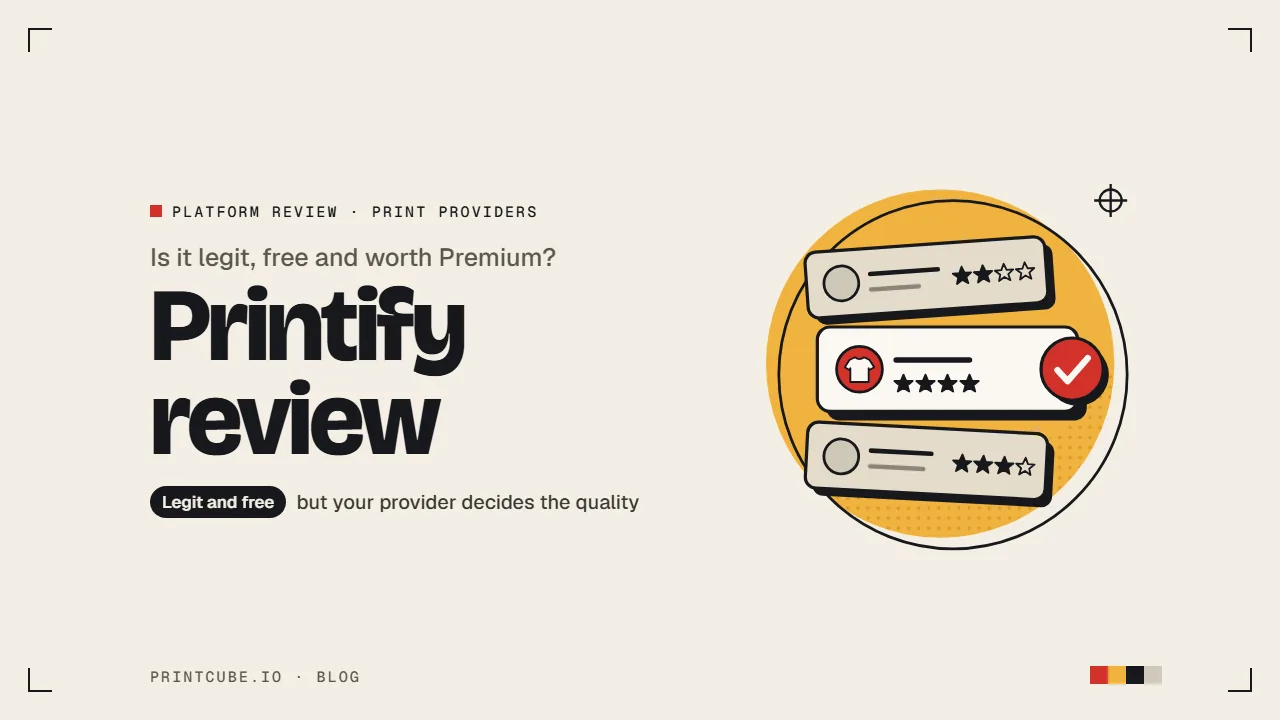

Printify is legit, and yes, you can use it for free. It's a real, established company, the Free plan costs $0 a month, and you only pay when a customer orders something. The catch is that Printify doesn't print your shirts. It passes each order to an outside print provider, and which one you choose decides most of what you'll like or dislike about it.
Printify Review: Is Printify Legit, and Is It Really Free?
The legitimacy worry usually starts with a horror story about a blurry print or an order that never showed up. Those stories are real, but they aren't signs of a scam. They come from how Printify is built.
Printify is a marketplace. It gives you the catalog, the design tool, the store connections and the billing. The printing, packing and shipping are done by independent print providers who list their services on the platform.
So two sellers can both "use Printify" and have very different experiences. One picked a provider that prints cleanly and ships on time. The other picked a different one for the same shirt and got faded ink. Printify's reputation among sellers is mixed for exactly that reason: you're really reviewing the provider you pick, and the platform around it is the dependable part.
On cost, the Free plan has no monthly fee, lets you connect up to 5 stores and doesn't limit your designs. When an order comes in, you pay the provider's production price plus shipping.
How Print Providers Work on Printify
Open any product in the catalog and you'll see a list of providers offering it. Each one sets its own price, its own shipping rates, its own location and its own print areas.
Here's a real example. For the Bella+Canvas 3001, a popular unisex tee, the catalog listed eight US providers at the time of writing, with starting prices from $11.43 to $14.98. Monster Digital started at $11.77 and printed the front, the back and an inner neck label. SwiftPOD started at $11.75 and added both sleeves. The shirt is the same in every case, but the cost and the options are not.
The cheapest line is tempting, but check three things first:
- Ratings and scores. Each provider shows how it has been performing on the platform. A provider that's a dollar cheaper but has a weaker record will cost you more in refunds and unhappy buyers.
- Location relative to your buyers. If most of your customers are in the US, a US provider usually means cheaper shipping and a shorter trip. If you sell to Europe, look for one there.
- Print areas. If your design needs a back print or a sleeve, confirm the provider offers it before you build the listing around it.
A provider that's slightly pricier but well rated and close to your customers is usually the better deal.
Printify Choice or Your Own Pick?
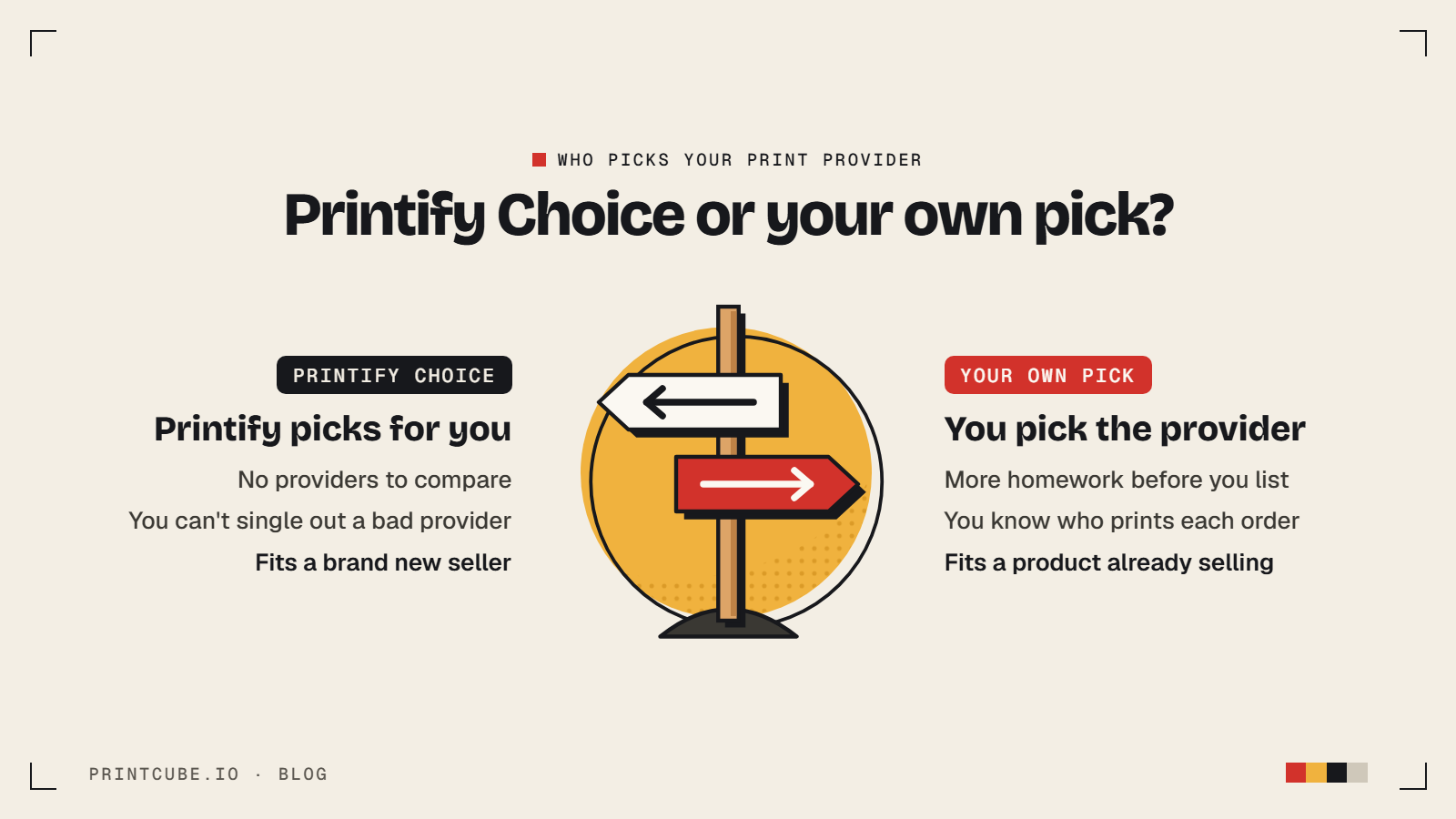
If comparing providers sounds like homework you don't want, Printify Choice is the hands-off option. You pick the product, and Printify decides who prints it.
That saves you work, but you give up control over who makes your product. If a batch comes out badly, you can't pin it on one provider and stop using them the way you could if you'd chosen them yourself.
Choice makes sense if you're brand new, you want a listing live this week, and you're selling simple products where small differences won't make or break you. It's a reasonable way to get started.
Once a product is selling, I'd pick the provider myself. By then you have a design that works and customers who expect the next shirt to look like the last one, and that's easier to protect when you know who's printing it.
What a T-Shirt Costs on Printify
Every order has two lines: the production price and the shipping. Printify's help center doesn't list any other per-order fee from Printify itself.
Take that same tee on Printify Choice, which listed it at $11.29 in sizes S to XL at the time of writing. You'll find the current price on the product's page in the catalog, next to each provider. For standard shipping within the US, Choice charged $4.95 for the first shirt and $2.40 for each extra shirt in the same order.
A customer buys one shirt:
- Production: $11.29
- Shipping: $4.95
- You pay: $16.24
A customer buys two:
- Production: $22.58
- Shipping: $4.95 + $2.40 = $7.35
- You pay: $29.93, or about $14.97 a shirt
Multi-item orders are a little kinder to you, because the second shirt costs much less to ship.
That isn't your full cost, though. Printify tells sellers to budget separately for whatever their sales channel charges. On Etsy, that means the listing fee, the cut Etsy takes from each sale, and payment processing. On Shopify, it's the monthly subscription plus payment processing on every order.
None of that goes to Printify, but it all comes out of the same sale. Before you set a price, add those fees to the $16.24 and see what's left.
What Printify Premium Costs and When It Pays Off
Premium is a monthly fee in exchange for cheaper products. You can see the plans side by side on Printify's pricing page.
| Plan | Cost | Stores | Product discount |
|---|---|---|---|
| Free | $0 a month | 5 | None |
| Premium | From $39 a month, or from $24.99 a month billed yearly ($299, plus tax) | 10 | Up to 20% off most products, up to 33% off select new products |
| Enterprise | Custom pricing | Unlimited | Extra discounts |
Premium also knocks up to 33% off neck labels and drops packaging inserts and gift messages from $0.25 to $0.15 each, which only matters if you use those extras.
Working out your own break-even
Divide the plan fee by what you save per item.
On that Printify Choice tee, Premium brought the price down from $11.29 to $9.04, a saving of $2.25. On the monthly plan, $39 divided by $2.25 is about 18 shirts a month before Premium has paid for itself. On the yearly plan, at roughly $25 a month, it's about 12.
The words "up to" matter here. The discount isn't a flat 20% across the catalog. If your particular product only gets 10% off, the saving on an $11.29 shirt is about $1.13, and the break-even roughly doubles to about 35 shirts a month on monthly billing and about 23 on yearly.
So check the Premium price shown for your own product with your own provider, then run the sum with that number.
The small print
- Don't count on the discount lowering your shipping. Plan as if it only touches the production price.
- Tax is added on top of the plan fee.
- The fee is non-refundable. If you want out, unsubscribe before the renewal date or you'll be charged for the next period.
The yearly plan is cheaper per month (Printify calls it a 36% saving), but you're paying $299 up front with no refund. I'd only take it once your monthly sales have been above break-even for a while.
Print Quality and What to Do When an Order Goes Wrong
Since each provider runs its own equipment and its own quality checks, "is Printify's quality good?" doesn't have one answer. It depends on which provider prints it.
So order a sample before your first sale. Use your real design, on the real product, from the specific provider you plan to sell with. A sample from a different provider tells you nothing about the one your customers will get.
When the sample arrives, check the things a buyer would notice: colors against your screen, placement, how the print feels, and how it looks after a wash. If you're happy, stick with that provider for that product.
Something will still go wrong eventually, as it does on every print-on-demand platform. Printify's help center spells out what happens next, and four points are worth knowing before your first sale:
- You have 30 calendar days from delivery to report a damaged item or a manufacturing error.
- You need a clear photo of the problem, so tell customers to send one. The item doesn't have to be sent back.
- When the product is damaged or the print is at fault, Printify offers a free reprint or a refund. A package that never arrives is reviewed case by case.
- A customer who changes their mind, or orders the wrong size or color, isn't covered. Printify doesn't support those returns or exchanges.
That last one catches new sellers out. These items are printed to order, so a simple "I don't want it" return comes out of your own pocket if you offer one. Write your store's return policy to match, so you don't promise something you'd have to pay for yourself.
Your customer deals with you and has probably never heard of Printify. When an order arrives wrong, you sort it out with them first, then take it up with Printify.
Printify Support: What to Expect
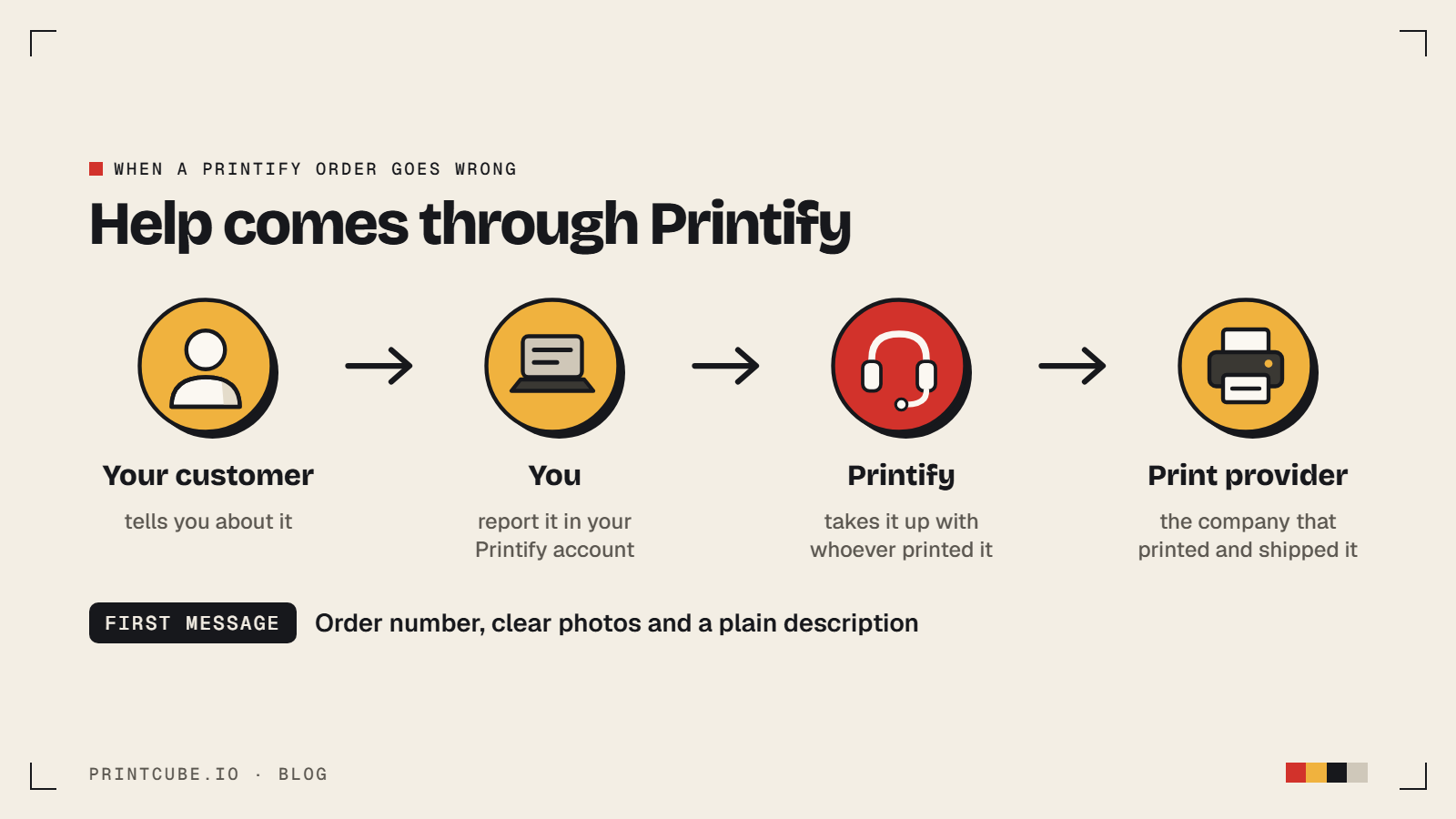
Help comes from Printify, not from the print provider. You raise a problem through your Printify account, and Printify takes it up with whoever printed the order. You don't have to chase a factory yourself, but there's a middleman between you and the people who can fix the problem.
That's the source of the usual grumbles: replies that feel slow when a customer is waiting, back-and-forth requests for more photos, and answers that read like templates. Sellers who've had smooth experiences tend to say the opposite, which fits the pattern of everything else on the platform.
You can make it easier by sending the order number, clear photos and a plain description in your first message. If being able to talk to someone in real time matters to you, check which contact options are offered right now before you commit.
Who Should Pick Printify
Printify suits you if you care about margin and you're willing to do some vetting. Sellers who compare providers, order samples and stay with the one that works get low costs and plenty of choice. Sellers who grab the cheapest provider without looking tend to be the ones writing the horror stories.
It's a weaker fit if you want one consistent print standard with no homework. If you just want every order to look the same without ever thinking about who printed it, the marketplace model will frustrate you.
On plans, start on Free. It's enough to launch, and paying for Premium before you have steady orders means spending money to save money you aren't making yet. Move up when your own break-even sum says so.
If you're still torn between Printify and Printful, our Printful vs Printify comparison works through what each leaves you on a $25 tee.
FAQ
Do I need a paid plan to connect a store?
No. The Free plan lets you connect up to 5 stores to one account, with unlimited designs. Premium raises that to 10 stores, and Enterprise removes the limit.
Can I switch print providers on a product later?
You can move a product to a different provider, but treat it as a new product. The price, shipping rates and print areas may all differ, so your design might need adjusting and your margins will shift. Order a fresh sample from the new provider before customers start receiving it.
Can I cancel Premium partway through a year?
You can unsubscribe, but the fee is non-refundable, so you won't get money back for the months you don't use. What unsubscribing does is stop the next renewal, as long as you do it before the renewal date.
Does the Premium discount lower shipping?
Don't plan on it. The discount is described as money off products, so work out your break-even using the production price only. If shipping does come out cheaper on an order, treat it as a bonus.