
If you sell a t-shirt for about $25, Printify can leave you a little more money than Printful, about 60 cents on one popular shirt, as long as you pick one of its cheaper print providers. Both platforms are free to start, and standard US shipping costs the same on each for that shirt, so the gap comes from what each one charges to make it. The catch is that Printify's cheaper price comes with more homework for you, and that part deserves as much attention as the dollars.
Which one leaves you more money on a $25 t-shirt?
Three costs come out of a sale before you see any of it: the base price (what the platform charges to make and print the shirt), shipping, and whatever your marketplace takes.
Marketplace fees are the same whichever platform prints the shirt, so they don't help you choose. Standard shipping on a single US t-shirt is $4.95 on Printful, and the same $4.95 on Printify Choice, where Printify picks the print provider for you. Neither charges you a monthly fee unless you opt into a paid plan.
That leaves base price. If one platform can make your shirt for a dollar less, that dollar is the difference in your pocket. So the useful question is why the two would price the same shirt differently at all.
One printer or many: how the two differ underneath
Printful does the printing itself. It runs its own fulfillment centers in North America and Europe, and uses partner facilities for some products and for a few countries, Australia and Japan among them. Either way you pick a shirt, you see one price, and Printful decides where it gets made.
Printify doesn't print anything itself. It's a marketplace of third-party print providers, and you choose which one makes your product. Each provider sets its own price and its own shipping rates, so the same blank tee can show up at several different prices depending on who you select.
That's why Printify can come out cheaper: providers compete, and you can shop among them. It's also why a "Printify price" doesn't really exist, only the price of the provider you picked.
Printful vs Printify: profit on one $25 shirt
The math is retail price minus base price, minus shipping, minus marketplace fees. Here's one shirt, sold at $25 with free shipping to a US buyer, so you're covering the postage.
The shirt is the Bella+Canvas 3001, a tee both platforms sell. The base prices are what each catalog listed for sizes S to XL at the time of writing: $11.92 on Printful and $11.29 on Printify Choice. Shipping is each one's standard US rate for a first t-shirt. The marketplace fee is an invented round number, since yours depends on where you sell.
| Printful | Printify (Printify Choice) | |
|---|---|---|
| Retail price | $25.00 | $25.00 |
| Base price | $11.92 | $11.29 |
| US shipping, first item | $4.95 | $4.95 |
| Marketplace fees (made up) | $3.50 | $3.50 |
| What you keep | $4.63 | $5.26 |
On this shirt Printify leaves you 63 cents more, and all of it is the base price. That's the best case, and it's the one where Printify chooses the printer for you. If you'd rather choose your own, the eight US providers listed for this shirt start anywhere from $11.43 to $14.98, and five of them start higher than Printful's $11.92. Pick one of those and it's Printful that leaves you more.
So before you decide, open both catalogs, find the same shirt model (or the closest match), and write down the real base price on each. Then swap those into the table along with your own marketplace's fees. It takes ten minutes and it's the only version of this comparison that applies to you.
Why US shipping shouldn't decide it
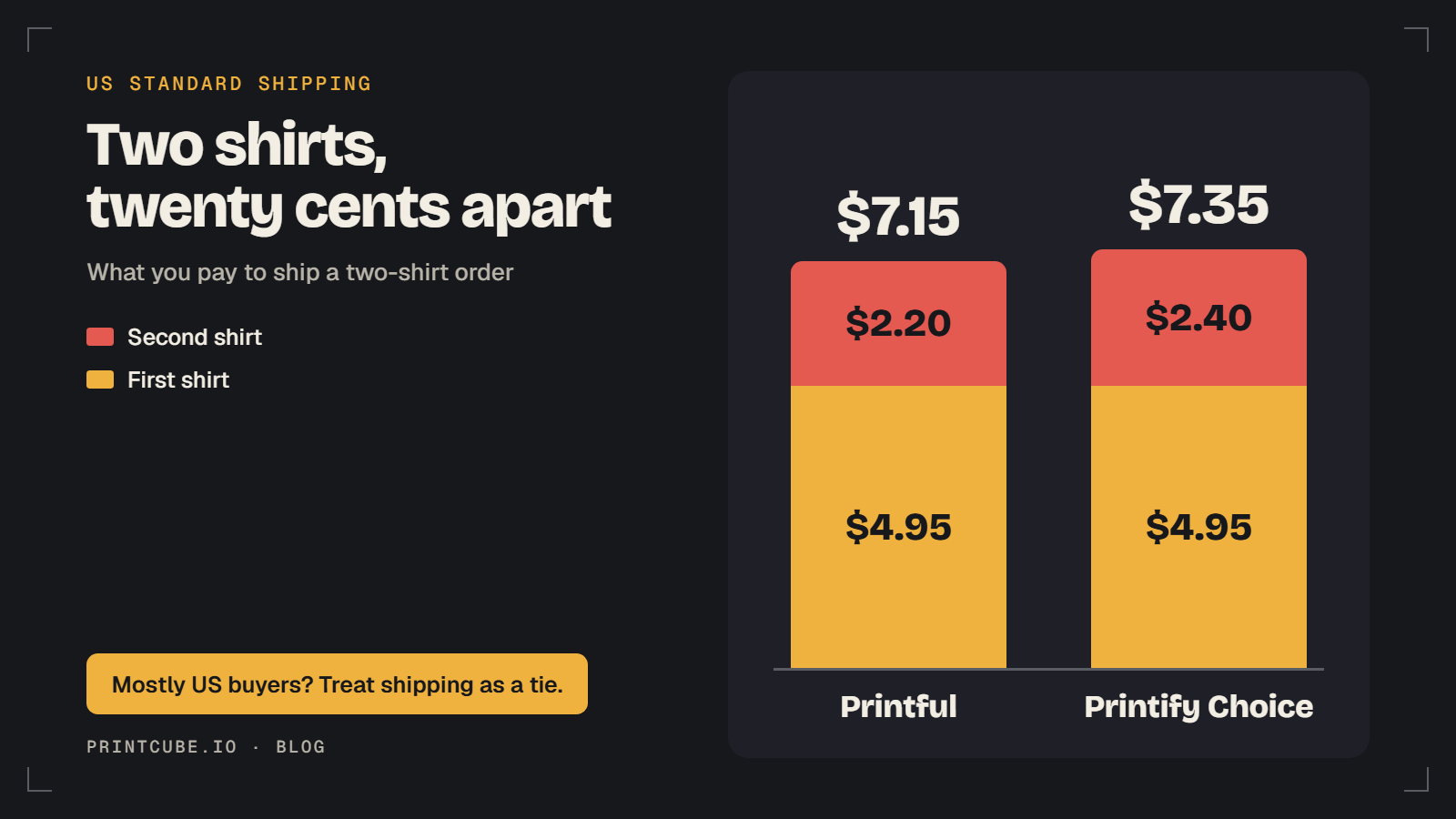
Shipping is too close to settle anything. When a customer orders two shirts, you pay the first-item rate once and a smaller rate for the second. On Printful that's $4.95 plus $2.20, so $7.15. On Printify Choice it's $4.95 plus $2.40, so $7.35. That's twenty cents on a two-shirt order.
Outside the US the numbers spread out a bit more. Printful's t-shirt shipping rates are $4.79 plus $1.50 for each additional shirt to the UK, $4.99 plus $1.45 to Europe, $8.59 plus $1.95 to Canada, and $7.99 plus $1.40 to Australia and New Zealand. Printify's help center shows one UK provider at $3.98 plus $1.29, which is noticeably cheaper, but that's one provider. Another may charge more.
On timing, Printful says it takes 2 to 5 business days to make and fulfill an order, then 3 to 4 business days for standard shipping within the US and Canada. On Printify, production and delivery times depend on the provider, so check the one you're considering.
If most of your buyers are in the US, treat shipping as a tie. The cost you do get to choose is whether to pay for a plan.
Is Printful Growth or Printify Premium worth paying for?
Both paid plans work the same way: you pay a monthly fee and get a discount on base prices. Whether that's a good deal depends entirely on how many items you sell.
Printify Premium is $39 a month, or $24.99 a month if you pay yearly. It gives up to 20% off most products and up to 33% off select new ones, and raises your store limit from 5 to 10. Printful Growth is $24.99 a month for up to 33% off product prices and 9% off product branding.
Take the same shirt. With Premium, Printify Choice lists it at $9.04 instead of $11.29, so you save $2.25 a shirt. To cover Premium at the yearly rate of $24.99 a month, you'd need to sell about 12 of them every month. At $39 a month, it's about 18. Below those numbers the plan costs you money.
Run the same sum for Growth. Printful's price for this shirt drops from $11.92 to $9.78 on the plan, which saves you $2.14, so it also takes about 12 shirts a month to cover the fee.
Two cautions. Both discounts are "up to" figures, so your product may get less than the maximum, and then the break-even climbs. Check the discounted price on your own product before subscribing. Also, Printify's yearly plan is a single $299 payment and it's non-refundable, so don't lock that in on the strength of one good month.
If you're selling five shirts a month, stay on the free plan on either platform. One nice touch on Printful's side: Growth becomes free for a year once your yearly sales reach $12,000, so a growing store eventually gets the discount without the fee.
Print quality and consistency: what the lower price trades away
With Printful, you don't pick a printer. Your order goes to one of Printful's own centers or to a partner it has chosen, and Printful answers for the result either way. That doesn't mean every shirt will be perfect, but the thirtieth shirt is likely to look like the first.
With Printify, quality is a property of the provider, not the platform. Two providers can print the same design on the same blank and give you different color, placement and feel. If you switch providers to save a dollar, you're effectively switching printers, and your customers may notice. That goes for Printify Choice too, since the provider can change from one order to the next.
You can take most of the risk out of this with a bit of care:
- Order a sample from the specific provider you plan to use, with your real design on it, before you list anything.
- Look at each provider's ratings and production times inside Printify, not just its price.
- Once you find a provider you're happy with, stick with it for that product. Sample again if you ever change.
Samples are a good idea on Printful too. A design that looks great on screen can print darker or smaller than you pictured, whoever makes it.
Then read each platform's policy on misprinted and damaged orders before your first sale. You're looking for three things: how many days you have to report a problem, what proof they want (usually photos), and whether you get a free reprint or a refund. A buyer with a flawed shirt will come to you, and you want to know what happens next before that message arrives.
Branding extras that come out of your margin
Custom branding makes a shirt feel like it came from a real label, and on Printful each piece has a price. An inside label is $0.99 per item. An outside label is $2.49. Premium images are $1 each. Embroidery needs your design digitized first, which is a one-time fee of $2.95 to $6.50 per design.
Go back to the Printful shirt that left you $4.63. Add an inside label and you're at $3.64. Add both labels and $3.48 comes off, leaving $1.15. That's a big bite for a detail many buyers won't comment on, so either raise your price to cover it or save it for products with more room.
The digitization fee is gentler, because you pay it once. A $6.50 fee spread over 50 sales of that design is 13 cents each. And if you do go heavy on branding, Growth's 9% off product branding trims those charges a little.
Check your product and your store before you commit
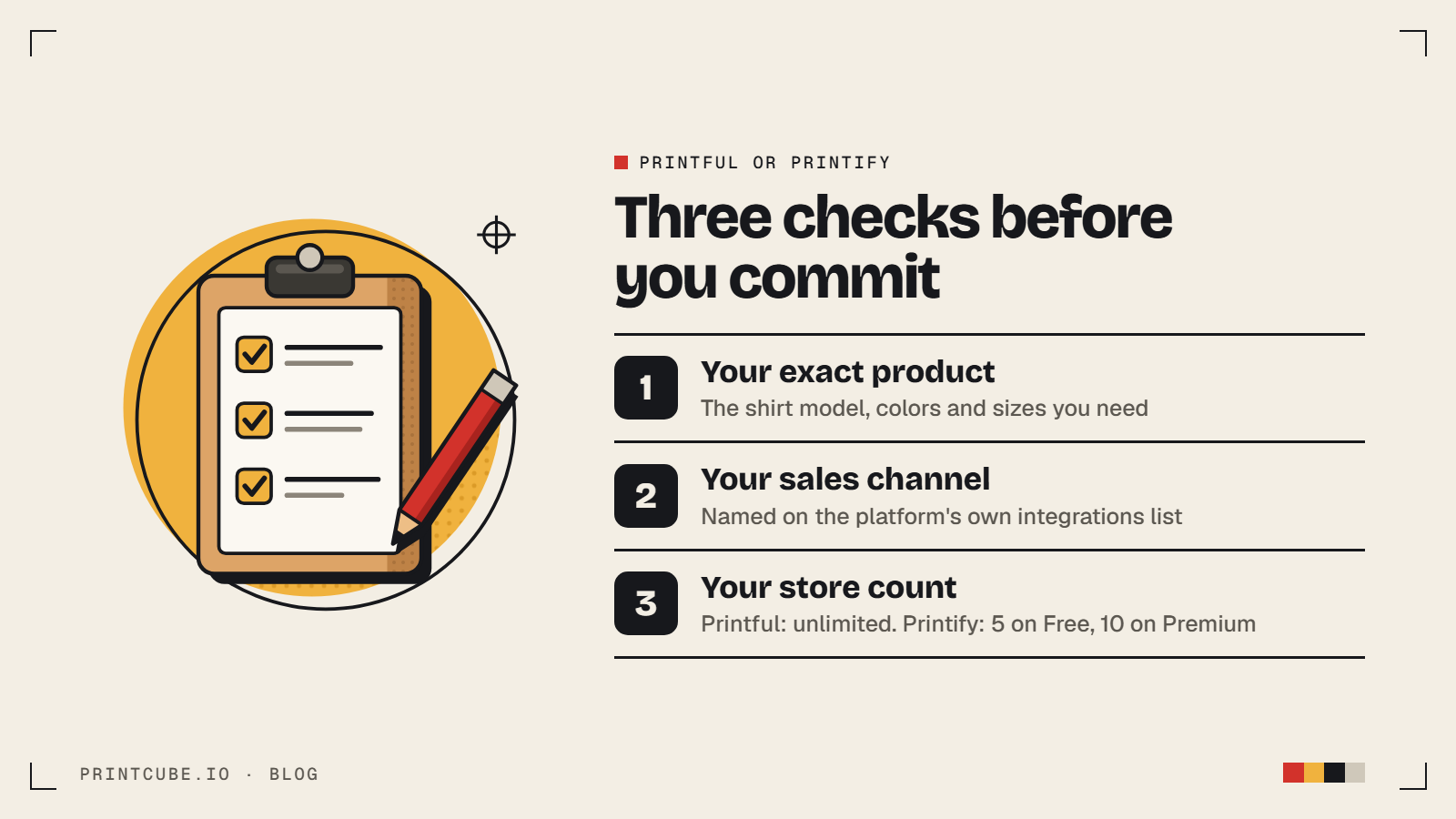
Price only matters if the platform makes what you want to sell and connects to where you sell it. Both are quick to check, and it's better to do it now than after you've built twenty listings.
Start with the product. Search each catalog for the exact item you have in mind: the shirt model, the colors, the sizes you need. On Printify, also check which providers offer it and where they ship from, since a product only one distant provider makes is a different proposition from one with several options near your buyers.
Then check your sales channel. Each platform publishes its own list of integrations, so look for yours by name, whether that's Etsy, Shopify, TikTok Shop, Amazon, WooCommerce or something else. Go by the platform's own list, because these change and secondhand lists go stale.
Think about store count too if you plan to run more than one shop. Printful's free plan allows unlimited stores. Printify's free plan allows up to 5, and Premium up to 10.
When Gelato deserves a look instead
Gelato is the third name that tends to come up, and the seller who should compare it is one whose buyers are mostly outside the US.
The reason is what it costs to reach them. Printful's shipping rate to Canada or Australia is a good deal higher than its US rate, even though it prints in Canada itself and works with a partner in Australia. And on Printify, a provider outside your buyer's country means a cross-border parcel, which is slower and can pick up customs charges. If another platform prints your product in the country your customer lives in and charges less to deliver it, that changes your margin on every one of those orders.
So if your orders mostly go to the UK, Europe, Canada or Australia, add Gelato to your comparison and check the same things on its own pages: where your specific product is produced, the base price, the shipping rate to your main country, any plan fee, and whether it connects to your store. Then run it through the same profit sum as the other two.
If your buyers are mainly in the US, you can skip this step.
Which one to pick, by type of seller
Brand new, a handful of designs, few orders. I'd start with Printful's free plan. One price, one printer, fewer decisions, and at five sales a month the extra 60 cents or so per shirt matters less than not having to vet providers. If your margin at Printful's base price is too thin to live with, go to Printify and put the effort into choosing a provider.
Focused on margin. Printify, on the free plan until you're past the break-even for Premium. Just accept that the lower price is a trade: you're doing the quality control that Printful does in-house. Sample first, and don't hop between providers.
Building a brand. Printful makes sense here, since the labels and consistent output are the point. Price your products with the branding fees already included so they don't quietly eat your profit.
Thinking of switching. Do the per-sale sum with real catalog prices for your best seller before you move anything. If the gain is under a dollar a shirt, the work of rebuilding listings and re-sampling probably isn't worth it. If it's more, move one product first and see how the orders go.
FAQ
Can I use Printful and Printify at the same time?
Yes. They're separate accounts and both are free to open, so you can use Printful for some products and Printify for others. Just check each platform's integration details for how it connects to your particular store, and keep track of which listing is fulfilled where.
Is Printify Premium worth it if I only sell a few items a month?
No. On the shirt in this article, Premium saves $2.25 an item, so you'd need around 12 items a month to cover the yearly rate and around 18 at $39 a month. With a few sales a month the fee is bigger than the savings, and the yearly payment is non-refundable.
What happens to shipping when a customer orders two shirts?
You pay the first-item rate once and a lower rate for each extra shirt. In the US that's $4.95 plus $2.20 on Printful, so $7.15, and $4.95 plus $2.40 on Printify Choice, so $7.35. On Printify, this assumes both shirts come from the same provider.