
For most new print on demand sellers, Etsy is the better place to start. Its fees take a bigger bite out of each sale, but it puts your shirts in front of people who are already shopping. A Shopify store costs you a monthly fee from day one and stays empty until you bring visitors yourself.
Shopify starts to make sense once you can send your own buyers to it, through a following, an email list, or ads that pay for themselves.
Why Etsy's higher fees can still be the better deal
Most comparisons stop at the fee lists and say Etsy is cheaper when you're small and Shopify is cheaper when you're big. On fees alone, that's true. But it leaves out the cost that matters most for a new seller, which is getting someone to your shop. Etsy's higher fees are mostly the price of shoppers you didn't have to find. Shopify's fees are lower because finding those shoppers is your job.
A marketplace full of shoppers vs an empty store you own
Picture your shirt on Etsy. Someone types "funny cat mom shirt" into Etsy search, and your listing shows up somewhere in the results. It sits next to hundreds or thousands of similar shirts, and Etsy's algorithm decides how high you rank. You're competing hard, but there's a crowd walking past your stall every day.
Now picture the same shirt on a Shopify store called something like MeowThreads.com. The store looks great, but nobody knows it exists. No one walks past. Unless you post the link, run an ad, or show up in Google results, the store gets no visitors at all.
Keep those two pictures in mind as you read the numbers. Etsy charges you more per sale and brings the crowd. Shopify charges you less per sale and leaves the crowd to you.
Etsy vs Shopify on one $30 t-shirt order
Say you sell a shirt for $25 and charge $5 shipping, so the buyer pays $30 (we'll leave sales tax out to keep it simple). Here's what each platform takes. The middle column is the same Etsy sale if the buyer came from one of Etsy's Offsite Ads, which we'll get to shortly.
| What you pay | Etsy | Etsy (Offsite Ads sale) | Shopify Basic |
|---|---|---|---|
| Listing fee | $0.20 | $0.20 | $0 |
| Transaction fee (6.5%) | $1.95 | $1.95 | $0 |
| Payment processing | $1.15 (3% + $0.25) | $1.15 | $1.17 (2.9% + $0.30) |
| Offsite Ads (15%) | n/a | $4.50 | n/a |
| Fees on this order | $3.30 | $7.80 | $1.17 |
| Monthly cost | $0 | $0 | $29 billed yearly, $39 billed monthly |
A few things about the Etsy column. The 6.5% transaction fee applies to the shipping you charge too, not just the shirt. The $0.20 listing fee is charged when you list, whether or not the item sells, and the listing renews automatically every four months or after a sale for another $0.20. Etsy also has a one-time shop setup fee that depends on where you live, and you'll see the amount when you sign up.
On Shopify, those card rates assume you use Shopify Payments. If you use a different payment provider, Shopify adds another 2% per order on the Basic plan, so most small sellers stick with Shopify Payments.
Remember that your supplier's base price and shipping come out of that same $30 on both platforms. Picking a supplier is a separate decision. This table only shows what the selling platform takes on top.
Redo it with your own price
You don't need a spreadsheet. On a regular Etsy sale, the fees work out to about 9.5% of the order total plus $0.45. On Shopify Basic, it's 2.9% plus $0.30.
If your order is $40, Etsy takes roughly $4.25 and Shopify takes about $1.46. The gap between them is about 6.6% of the order plus $0.15, so it grows as your prices go up.
When Shopify's monthly plan pays for itself
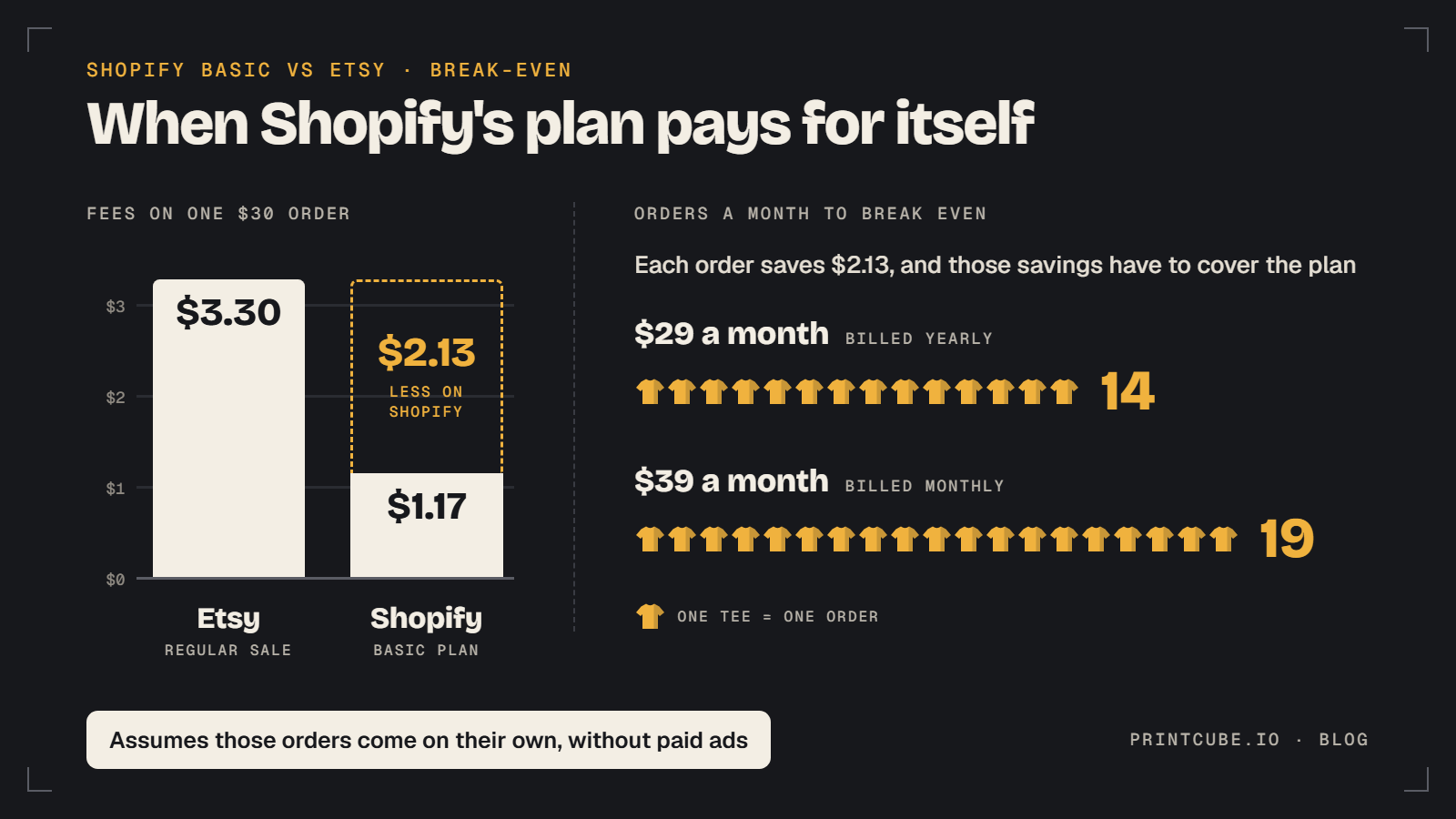
On a $30 order, Etsy costs you $2.13 more than Shopify's card fee ($3.30 minus $1.17). Those savings have to cover Shopify's monthly plan before it comes out ahead.
- On the $29 yearly plan, you need about 14 orders a month to break even.
- On the $39 monthly plan, you need about 19 orders a month.
Below that, Etsy leaves you with more money. Above it, Shopify does, at least on paper. Paid themes and apps can push the Shopify number higher, since many stores end up paying for a few.
That break-even assumes those 14 or 19 orders show up on their own, and on Shopify they don't. If even part of that traffic comes from paid ads, the savings can disappear fast. So the useful question isn't whether Shopify is cheaper at 14 orders. It's whether you can get 14 orders a month to a Shopify store without spending more than $2.13 per order to find each buyer.
The plan prices above are for Shopify's Basic plan, which is all a new print on demand seller needs. The bigger plans (Grow, Advanced and Plus) are built for much larger shops. You can see the current numbers on Shopify's pricing page.
Offsite Ads and when you lose the opt-out
Offsite Ads is the fee that surprises Etsy sellers most. Etsy pays to advertise listings on places like Google and social media. If a shopper clicks one of those ads and buys from your shop within 30 days, Etsy charges you a percentage of that order.
- 15% of the order if your shop has never made $10,000 in any 365-day period.
- 12% if it has.
- The fee is capped at $100 per order.
On our $30 shirt, that's an extra $4.50, which more than doubles your Etsy fees on that sale. Once you take out the supplier's base price, a 15% fee can wipe out most of your profit on a cheap shirt.
While your shop is under the $10,000 line, you can turn Offsite Ads off in your shop settings. After your shop has earned $10,000 in any 365-day period, it becomes mandatory, and you can't opt out again even if your sales drop later. Many sellers keep it on early because the extra exposure can help, but if your margins are thin, it's worth switching off and seeing whether you miss it.
Getting people to a Shopify store
This is where most new Shopify stores struggle. Here are the usual ways people bring in visitors, and what each one asks of you.
- Social media. Posting your designs on TikTok, Instagram or Pinterest is free, but it takes steady work, and plenty of accounts post for months without much happening. It works best if you already have a following.
- Paid ads. Fast to start, but you pay whether or not anyone buys. Say you spend $8 on ads to get one $30 sale. You just saved $2.13 in fees compared with Etsy and spent $8 to get the buyer, so you're about $6 worse off than if the shirt had sold on Etsy.
- Email. Probably the cheapest way to get repeat sales, but you need a list first, and an empty store doesn't build one quickly.
- Search. Getting your store into Google results for things people search for can bring free traffic, but it often takes months to build up.
None of these is guaranteed to work, and most take a while. That's not a reason to avoid Shopify. It's a reason to start one when you already have a way to bring people in, rather than hoping you'll figure it out after paying for the plan.
If you go ahead, Shopify's trial keeps the setup cheap. You get 3 days free, then $1 a month for 3 months, which gives you time to build the store and try a traffic channel before the full price starts.
Connecting Printful, Printify or Gelato
All three of the big print on demand suppliers connect to both Etsy and Shopify. You link your shop in the supplier's dashboard, add your designs to their products, and push the listings across. When an order comes in, it goes to the supplier automatically, and they print and ship it.
Connecting is free. Each supplier offers paid plans with extras like discounts on base prices, but you don't need them to get started. If you're curious what's included, Printful lists its pricing and membership plans on its site.
You can connect the same supplier to both platforms at once, which matters if you end up selling on both later.
Etsy's rules for print on demand
Print on demand is allowed on Etsy, but Etsy expects you to be open about it. When you create a listing, you choose who made the item. For print on demand, that's the "Designed by" option, since you created the design and someone else produces it. You then add your supplier as a production partner in your shop settings and attach it to those listings.
The design has to be your own, or something you have the rights to use. Sellers who list generic designs they didn't create, or who use trademarked characters and logos, risk having listings removed or their shop suspended.
Etsy updates its wording from time to time, so use whatever labels its listing form shows when you set up.
On Shopify, there's no category to pick and no partner to disclose. It's your store, so you decide how to describe your products, though the usual rules about copyright and trademarks still apply.
Branding, your domain and your customers
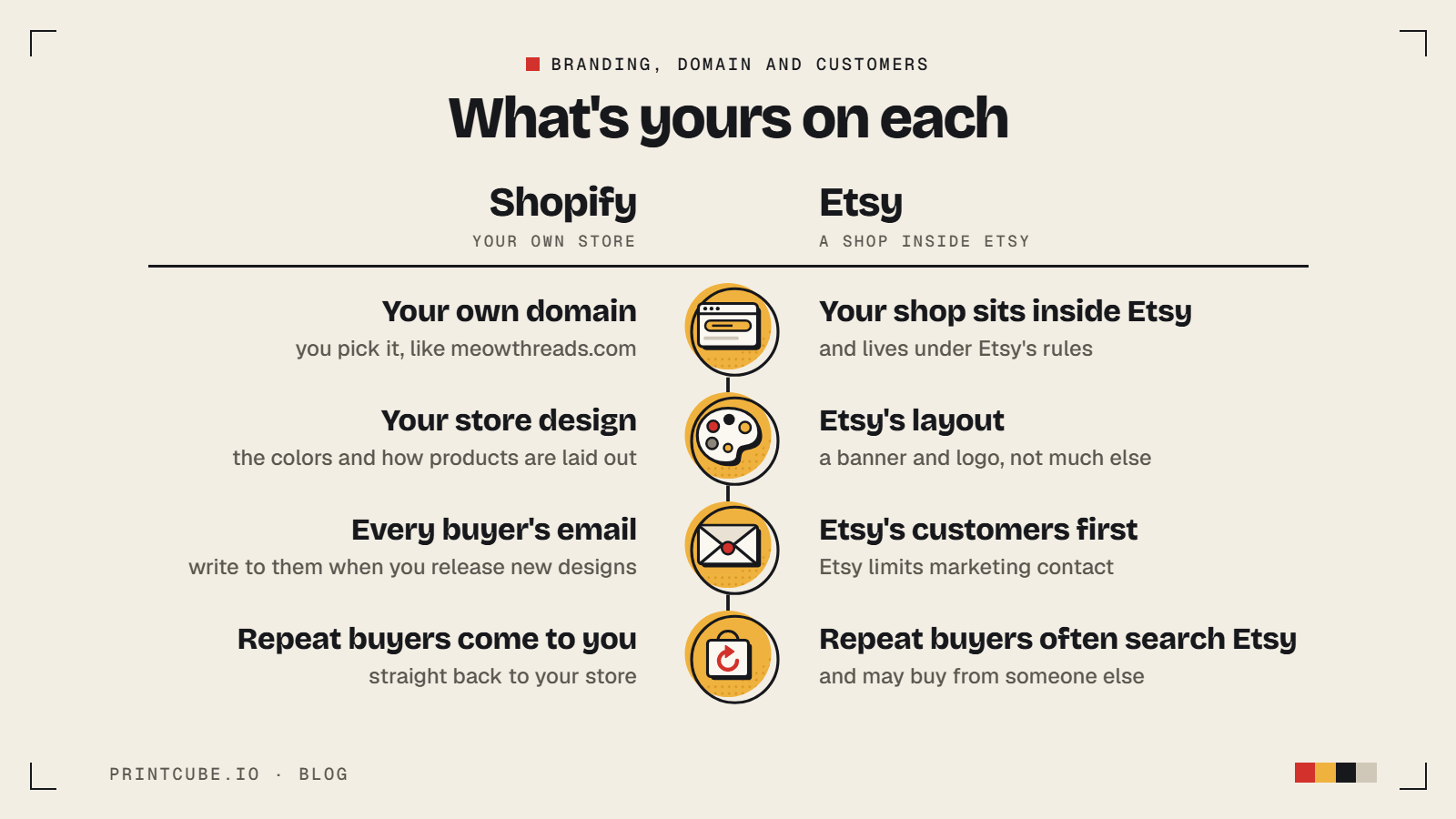
Branding control sounds abstract, so here's what it looks like day to day.
On Shopify, you choose your domain, like meowthreads.com. You pick the store design, the colors and how products are laid out. Every buyer's email address is yours, and you can send them a note when you release new designs. If someone loves their shirt and comes back a year later, they come straight to you.
On Etsy, your shop sits inside Etsy's layout, with a banner and logo but not much else to customize. Buyers are Etsy's customers first. Etsy limits how you can contact them for marketing, and when a happy buyer comes back, they often search Etsy again and may end up buying from someone else. Your shop also lives under Etsy's rules, so a policy change or account issue can affect your whole business overnight.
For a lot of sellers, this matters more than the fees. A list of past buyers you can email is something you can keep building on. Etsy sales help you make money now, but most of the repeat business stays with Etsy.
Selling on both, and when to add the second
A common path is to start on Etsy, find out which designs sell, and then add a Shopify store as a home for your brand. Etsy works well for testing because buyers are already there to tell you what they like. Shopify becomes worthwhile once some of those buyers want to come to you directly.
Signs it's time to add Shopify:
- Repeat buyers ask where else they can find you, or come back looking for new designs.
- You have a following that buys. If your posts lead to sales, you can send those people to a store where you keep more of each order.
- You've passed $10,000 in a year on Etsy. Offsite Ads is now mandatory, so sales you bring in yourself are worth more on your own store, where no one charges an ad fee on them.
Adding Shopify doesn't mean leaving Etsy. Etsy can keep bringing new buyers while Shopify holds on to the ones who come back. Since your supplier connects to both, you don't have to rebuild your products from scratch.
Which one I'd pick in your shoes
First shop, no audience: Etsy. You'll pay more per sale, but you'll have a real chance of being found while you learn which designs work. Keep an eye on Offsite Ads, and turn it off while you still can if 15% eats too much of your profit.
You already have followers or an email list: Shopify. Use the trial to set up for a few dollars, then send your audience there. You'll keep more of each sale and own the customer relationship from the start.
You're selling steadily on Etsy: Keep your Etsy shop and add Shopify alongside it once people have a reason to come to you directly. Moving everything over would mean giving up the shoppers Etsy brings, and that's the main thing your fees are paying for.
FAQ
Can I turn off Etsy Offsite Ads?
Yes, as long as your shop has never made $10,000 in any 365-day period. You'll find the setting in your shop's advertising settings. Once you've crossed that line, Offsite Ads stays on for good, at the lower 12% rate.
Do I need to pay for Printful, Printify or Gelato to connect them?
No. Connecting any of them to Etsy or Shopify is free, and you only pay for products when an order comes in. Their paid plans are optional extras.
Does Shopify have a free trial, and which plan do I need?
Shopify gives you 3 days free, then $1 a month for 3 months. The Basic plan covers everything a new print on demand store needs. Billing yearly brings it to $29 a month instead of $39.
Can I sell the same designs on Etsy and Shopify at the same time?
Yes, and plenty of sellers do. Connect the same supplier to both shops and publish your designs to each. Because the supplier prints each order as it comes in, you don't have to track stock across the two.