
If you're looking for sites like Redbubble, the honest answer is that nothing swaps in one-for-one. These marketplaces pay you in three different ways, and each one pulls a different crowd of shoppers. Most are free to list on, so the realistic move is to keep your Redbubble shop and add one or two sites that suit what you make.
There's no single Redbubble replacement, but there are good second homes
Here's the quick match by art type, and the rest of the article fills in the reasoning.
- Fandom, pop culture and funny t-shirt designs: TeePublic is the closest cousin to Redbubble.
- Illustration-led tees: Threadless is the natural fit.
- Wall art and home decor: Society6 is the classic home for it, though you can't just walk in anymore.
- Wedding invitations, cards and personalized gifts: Zazzle.
- Simple, broad-appeal shirt designs: Amazon Merch on Demand, if you can get accepted, or Spreadshirt.
Will you earn more on any of them? Maybe, but not because the rate is automatically better. On several of these sites, the platform decides which tier you're in or whether you get in at all, and that affects what you're paid and whether shoppers can find you. It's worth seeing what Redbubble takes first, so you have something to measure against.
What Redbubble takes from your earnings now
Opening a Redbubble shop is still free. You earn by adding a markup on top of Redbubble's base price, and the default is 10%.
The catch is the account tier. Redbubble puts every artist into Standard, Premium or Pro, and charges a platform fee on your monthly earnings based on that tier:
- Standard: 50%
- Premium: 20%
- Pro: no fee
Say you're a Standard artist and you sell a shirt where your markup comes to $4. Redbubble's platform fee takes half, and you keep $2. On Premium, the fee would be 80 cents and you'd keep $3.20.
Raising your markup doesn't get you around this. Standard and Premium artists also pay a 50% excess markup fee on whatever they earn from markup above 20%. So pushing your markup to 30% doesn't help as much as it looks, because the slice above 20% gets cut in half.
There are two small comforts. The two fees together are capped at $150 per monthly payment period, so a strong month doesn't get taxed forever. And the fees only ever come out of sales, so you'll never get a bill. You do need to reach $10 before Redbubble pays out.
What frustrates people most is that you can't sell your way out of Standard. Redbubble assigns the tier based on where your artwork comes from, the quality of your files and how appealing it thinks the work is. Sales volume isn't the test. Standard tends to go to accounts with lots of low-effort or repetitive designs, and Pro is invite-only for the top 1%, reviewed once a year.
If you're stuck in Standard and keeping half, another site is worth a look. Just know that some of the alternatives sort you into tiers too.
Sites like Redbubble, compared by how they pay and who shops there
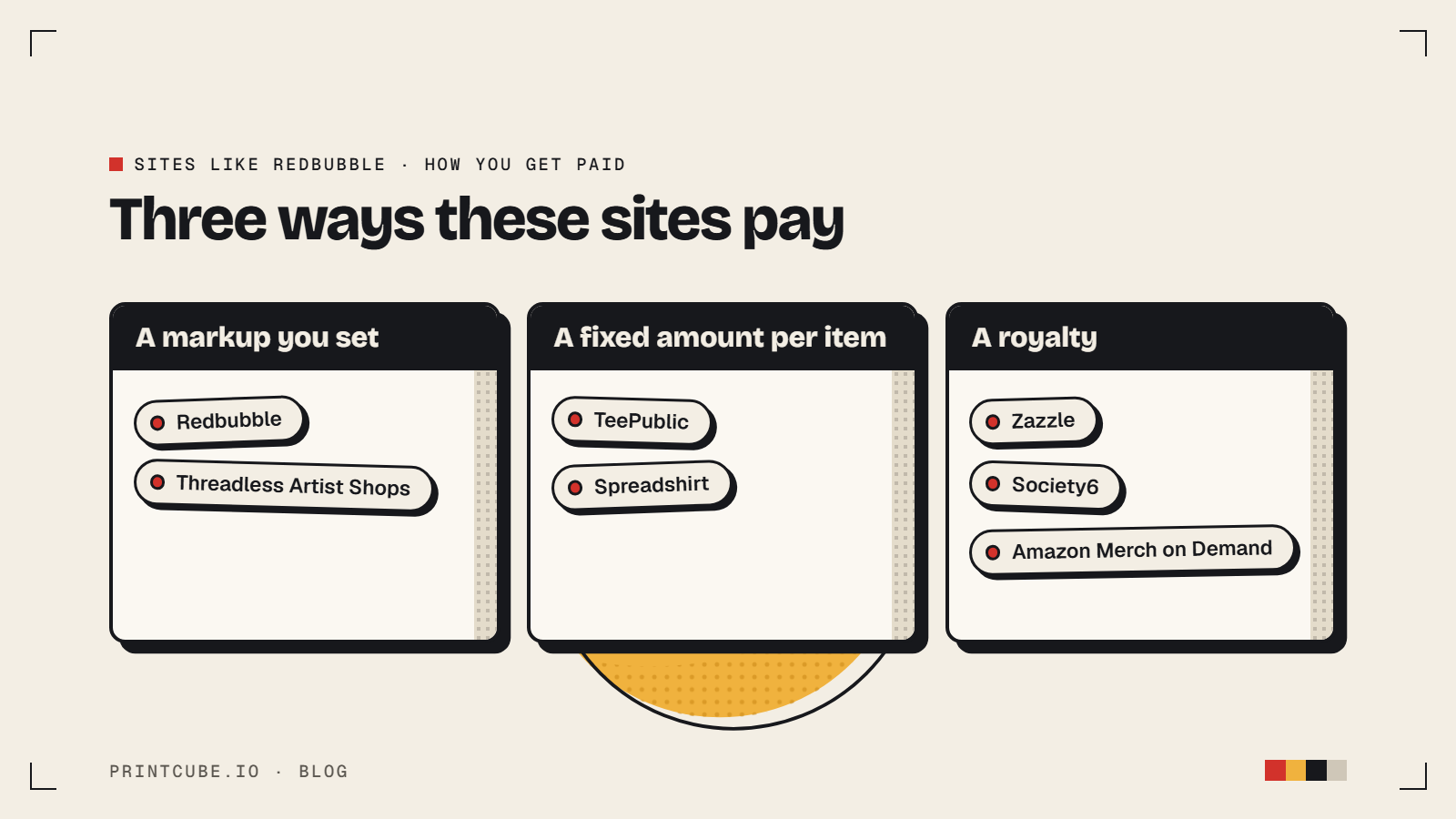
Before the table, it helps to know the three ways these sites hand you money.
A markup you set. The site has a base price for each product and you add your margin on top. Redbubble works this way, and so does a Threadless Artist Shop. You control the price, and with it how competitive you are.
A fixed amount per item. The site sets the retail price and tells you what you'll get for each shirt, sticker or mug. TeePublic does this, and so does Spreadshirt's marketplace. It's simple, but you have no levers to pull.
A royalty. You earn a share of each sale. On Zazzle you choose your own royalty percentage, and a higher one raises the price the shopper sees. On Amazon Merch on Demand you set the list price, and your royalty is what's left after Amazon takes out its costs and fees. Society6 pays a share too, but it sets the percentage.
| Site | How it pays | Cost to join | Who controls your tier or entry | Who shops there |
|---|---|---|---|---|
| TeePublic | Fixed amount per product, based on your account category | Free | TeePublic assigns Artisan or Apprentice; no upgrade requests | Fandom, pop culture and t-shirt buyers |
| Society6 | A markup Society6 sets: 10% of its base price on wall art, pillows and tapestries, 5% on the rest | No fee listed; by application | Society6 reviews every application | Wall art and home decor buyers |
| Zazzle | A royalty you choose, from 5% to 50% on physical products | Free | Open sign-up | Gift, invitation and personalization buyers |
| Threadless | Your price minus the base cost in an Artist Shop; a flat 10% on its marketplace | Free | You open your own Artist Shop | Fans of illustrated, art-led tees |
| Spreadshirt | A set amount per product, which it calls the design price | Free | Open sign-up, with 10 published designs to start | Slogan and casual apparel buyers |
| Amazon Merch on Demand | Royalty left after Amazon's costs and fees | Free, by application | Amazon approves you and limits how many designs you can list | Amazon shoppers searching for a specific shirt |
A closer look at each site
TeePublic
TeePublic is owned by the same company as Redbubble, and it shows. The shoppers are similar, and so is the habit of sorting artists into groups.
Instead of a markup, you get a set amount per product. How much depends on your account category: Artisan or Apprentice. Artisan accounts earn more on most products. When you first join, your account shows as "Pending," and during that stretch you earn at the Apprentice level.
Like Redbubble, TeePublic picks your category itself, based on design quality, skill, how many designs you have and consumer appeal. Sales don't decide it, and TeePublic says it won't act on requests to be upgraded.
The category also affects whether shoppers can find you, because Apprentice accounts aren't eligible to appear in TeePublic's site search. An Apprentice shop can still make sales, but mostly from traffic you send yourself or from shoppers who land on your page some other way. If you were hoping TeePublic's shoppers would stumble on your designs, that only happens once you're an Artisan.
You also won't always get the full rate. TeePublic pays a lower "sale" rate in four situations:
- during site-wide sales
- in a design's first 72 hours on the site
- when the customer uses a coupon
- on bundles
TeePublic runs sales often, so a fair share of your orders may land at the lower rate. Look at both the regular and sale amounts on TeePublic's earnings page before you estimate anything.
Payment is tidy: on the 15th of each month you're paid for the previous month's sales, in USD, through PayPal or Payoneer.
Society6
Society6 is where people go for art prints, framed pieces, throw pillows and the like. If your work looks good on a living room wall, these are your buyers.
The problem is getting in. Society6 no longer lets anyone open a shop. You fill in an application with a link to your portfolio, a person on its team reviews it, and it says it doesn't take AI-generated art or stock photos. Don't build your plan around it until you've applied and heard back.
If you do get in, you don't set your own price. Society6 adds a markup to its base price, and that markup is what you earn: 10% on pillows, wall tapestries, art prints, framed prints and posters, and 5% on everything else. Its own example is a throw pillow with a $35 base price, which pays the artist $3.50.
Zazzle
Zazzle shoppers usually arrive with an occasion in mind: a wedding, a baby shower, a business launch, a birthday. They want invitations, cards and gifts they can personalize with names and dates.
That means the winning designs are templates more than finished artwork. If you enjoy making things other people customize, Zazzle rewards it. You choose your royalty percentage, anywhere from 5% to 50% on physical products, and since a higher one raises the shopper's price, it's a balance. Zazzle recommends 5% to 10%. Go above 10% and it takes an excess royalty fee of 5% of your royalty.
Threadless
Threadless has a long history with illustrators, and its audience likes shirts that look like art, not slogans. You open your own Artist Shop for free, set your prices above the base cost and keep the difference. The base cost is the product's cost plus a 5% processing fee on your retail price. If a design sells on the main Threadless marketplace, you get a flat 10% of the purchase price. Threadless explains the math on its page about how Artist Earnings work.
An Artist Shop behaves more like a mini storefront than a marketplace listing, so expect to bring some of your own traffic.
Spreadshirt
Spreadshirt is apparel-first and has a strong following in Europe, which is handy if your designs or your audience lean that way. Text-based and casual designs fit well. On its marketplace you earn a set amount per product sold, which Spreadshirt calls the design price. It depends on the product and the country, and discounts can lower it. New designers start with a limit of 10 published designs, and Spreadshirt's design team checks those ten before it raises the limit to 50. You can also run a free shop of your own on its platform, where you set your own margin.
Amazon Merch on Demand
Amazon's draw is obvious: it's where people already shop. Buyers there search for something specific, like a shirt for a nurse who loves camping, and buy the first good match. Designs that are easy to describe in words do better than abstract art.
You can't just sign up, though. You apply, Amazon decides, and a new account starts at Tier 10, which means 10 published designs. The pay per shirt is modest: Amazon's own example for a standard t-shirt listed at $19.99 is a $2.44 royalty at the starting rate. It's worth applying early and treating it as a bonus if it comes through.
Can you upload the same designs to several sites?
In general, yes, and that's how most sellers use these sites. Marketplaces like these typically take a non-exclusive license, which means you keep ownership and can sell the same design elsewhere.
Don't take that on faith for every site, though. Before uploading, open the user agreement and look for two things: the word "non-exclusive" next to the license you're granting, and any clause about exclusive designs or special programs you've opted into. It takes five minutes per site.
The bigger risk is upkeep. Every site wants different file sizes, tags and product settings, and six half-finished shops do less for you than two tidy ones. A sensible way to spread out:
- Pick one new site that matches your art.
- Upload your ten or twenty best sellers, not your whole catalog.
- Give it a couple of months and see what moves.
- Only then decide whether to add more designs or a third site.
Keep a simple spreadsheet of what's uploaded where. You'll be glad of it the day you need to take a design down everywhere.
Where Etsy fits
Etsy gets lumped in with Redbubble alternatives, but it's a different animal. It has the shoppers, and lots of them, but it doesn't print anything.
So you connect a print provider to your Etsy shop. When an order comes in, the provider prints and ships it and charges you for the product and shipping. Etsy then takes its own cut: a fee to list each item, a percentage of each sale and a payment processing fee.
That means two sets of costs come out before you see anything, and you have to price with both in mind. In exchange, you set your own prices in full, nobody assigns you a tier, and the shop is recognizably yours. You also handle customer messages and any problems with orders.
Think of Etsy as the halfway step. You're still borrowing someone else's shoppers, but you're running the business side yourself.
When your own store wins
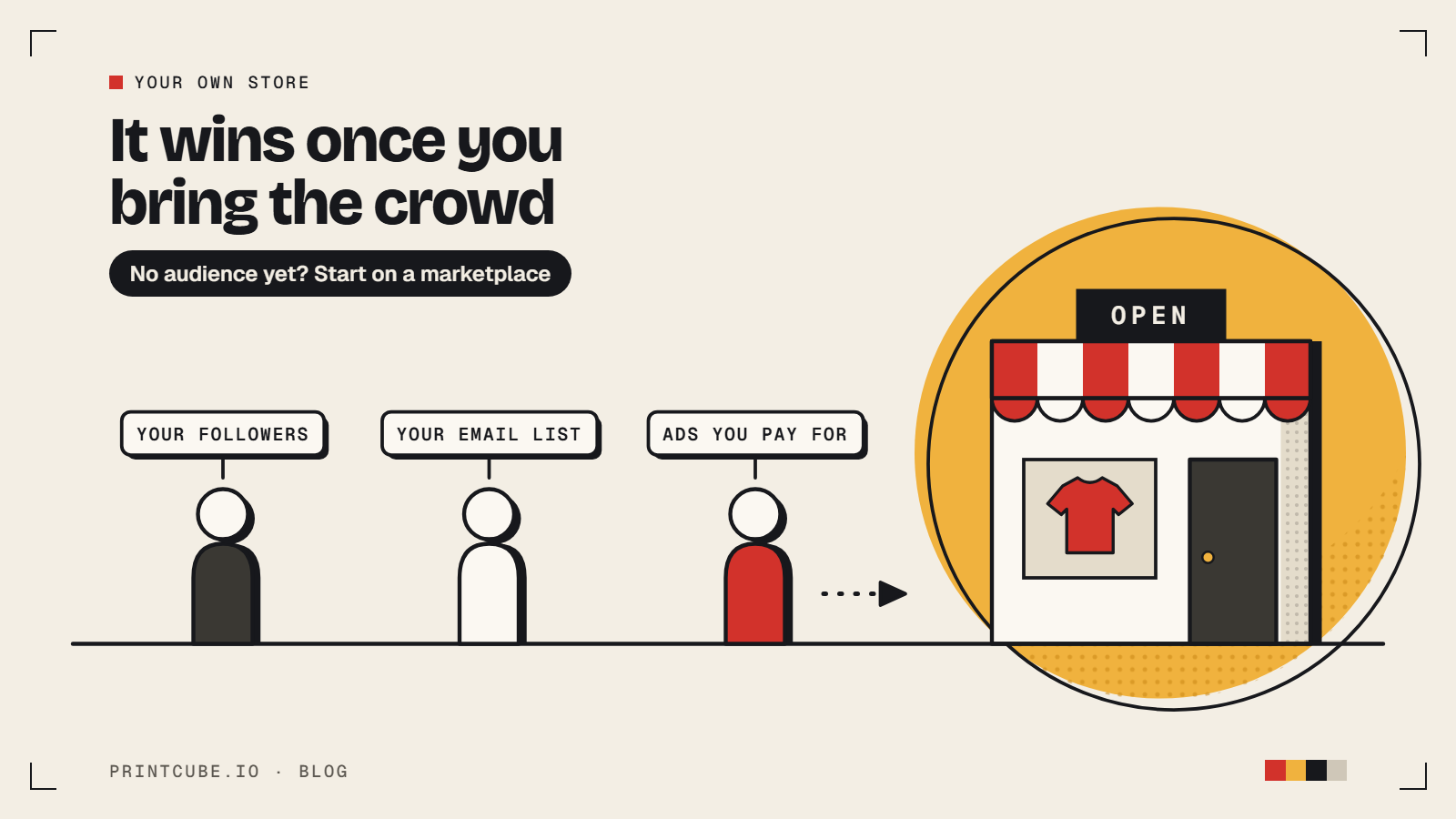
Your own store wins once you have people to send to it, and not before.
A standalone store has no browsing shoppers. Every visitor comes from your Instagram, your email list, your TikTok or ads you pay for. If you have a few thousand followers who ask where to buy your stuff, your own store lets you keep more of each sale and collect customer emails, which no marketplace will give you.
If you don't have that audience yet, a store is a monthly bill with no visitors. Start on marketplaces, build a following alongside, and open the store when people start asking for it.
Which site to pick for your kind of art
You make fandom, pop culture or joke tees. Add TeePublic. It's the nearest thing to Redbubble's audience. Go in knowing you'll start at the Apprentice level and may not show in search until TeePublic moves you up.
You're an illustrator with a distinct style. Open a Threadless Artist Shop, and keep Redbubble for stickers and smaller items.
You make wall art, patterns or decor-friendly work. Find out whether Society6 will have you. If not, Etsy with a print provider is a better route for prints than squeezing decor art onto t-shirt sites.
You like designing templates and giftable things. Zazzle, without much hesitation. It's the only one here built around personalization.
Your designs are simple, text-led and aimed at a clear group of people. Apply to Amazon Merch on Demand now, and use Spreadshirt while you wait.
You're on Redbubble's Standard tier and fed up. Don't delete anything. Your shop costs nothing to keep, and fees only come out of sales. Put your energy into one second site, and into the quality and originality of your uploads, since that's what both Redbubble and TeePublic say they judge.
FAQ
Is TeePublic better than Redbubble?
It's different more than better. TeePublic pays a fixed amount per product, where Redbubble pays your markup minus fees, so which one comes out ahead depends on your tier on Redbubble and your category on TeePublic. For t-shirt-heavy shops it's a strong second site. For an Apprentice account that can't appear in search, it may be quiet.
Can anyone still join Society6?
No. Society6 now chooses the artists it works with. You apply with a link to your portfolio, a person reviews it, and not everyone gets in, so don't plan around it until you've heard back.
Are these sites free to join?
TeePublic, Zazzle, Threadless, Spreadshirt and Amazon Merch on Demand don't charge you to open an account or list designs. They make their money from each sale. Redbubble is free to join too, with its account fees taken out of your earnings. Etsy is the exception, since it charges listing and selling fees on top of what your print provider charges.
Where else can I sell stickers?
TeePublic sells stickers to much the same crowd as Redbubble, so start there. Zazzle offers them too, and they suit its personalization shoppers. If stickers are your main product, an Etsy shop paired with a print provider gives you the most control over pricing and packs.
Should I leave Redbubble completely?
Probably not. Keeping your shop open costs nothing, and existing designs can keep picking up the odd sale. The better move is to stop relying on it alone.