
Your 13 Etsy tags should be short phrases a buyer would type into the search bar, each aimed at a different kind of shopper. If you sell print on demand, this matters more than usual. Thousands of shops offer the same black tee and the same white mug, so your tags are where you describe what makes yours different: the design, the person it's for, and why they're buying it.
What to put in your 13 tag boxes
If you're looking at a freshly synced listing with empty tag boxes, follow these four rules:
- Use all 13. Each empty slot is one fewer search your listing can show up for.
- Write phrases, not single words. "Dog mom mug" works better than "mug." Type each tag the way a shopper would.
- Cover different angles. Spread your tags across what the item is, who it's for, the occasion, and the style. Thirteen versions of the same phrase only cover one search.
- Leave color, size and material to attributes. Etsy has separate fields for those details. Fill them in, and save your tags for things those fields can't say.
How Etsy tags work with your title, category and attributes
Etsy search works in two steps. First it finds every listing that matches what the shopper typed. Then it ranks those matches. To decide whether your listing matches, Etsy looks at your title, tags, category and attributes together as one pool of keywords.
So you don't need every important word in every field. If your title says "Plant Dad Shirt" and your attributes say the shirt is green, a shopper searching "green plant dad shirt" can still find you. Your tags fill in what the other fields miss: the recipient, the occasion, other names for the product, and the search terms a gift shopper might use.
Etsy's own guidance says tags work best for terms no attribute covers and for what shoppers have in mind, like "gift for her." It also says a varied, accurate set of tags can help your visibility.
Put the clearest description at the start of your title and keep it readable. A title stuffed with every keyword looks spammy to shoppers, and it doesn't need to be. Your tags can carry the extra phrases.
Check your synced listing before you write a single tag
When Printify, Printful or Gelato pushes a product to Etsy, it fills in some fields for you. Some of what it fills in is useful and some is filler. Before you start on tags, check these three things.
The title. Templates often send something like "Unisex Heavy Cotton Tee" or "Ceramic Mug 11oz." That describes the blank, not your product. Rewrite it so it starts with your design and what the item is, like "Retro Plant Dad Shirt."
The category. Make sure the listing is in the most specific category that fits, such as t-shirts under clothing instead of a general apparel bucket. The category decides which attributes you can fill in. A vague category can also hurt how Etsy places you.
The attributes. These are often left blank after a sync. Go through every one that appears: primary color, secondary color, sizes, occasion, holiday, and anything else your category offers. Once your attributes say "white" and "cotton," you don't need to spend tags on those words.
This takes about two minutes per listing, and it gives your tags room for more useful phrases.
The tag rules Etsy sets
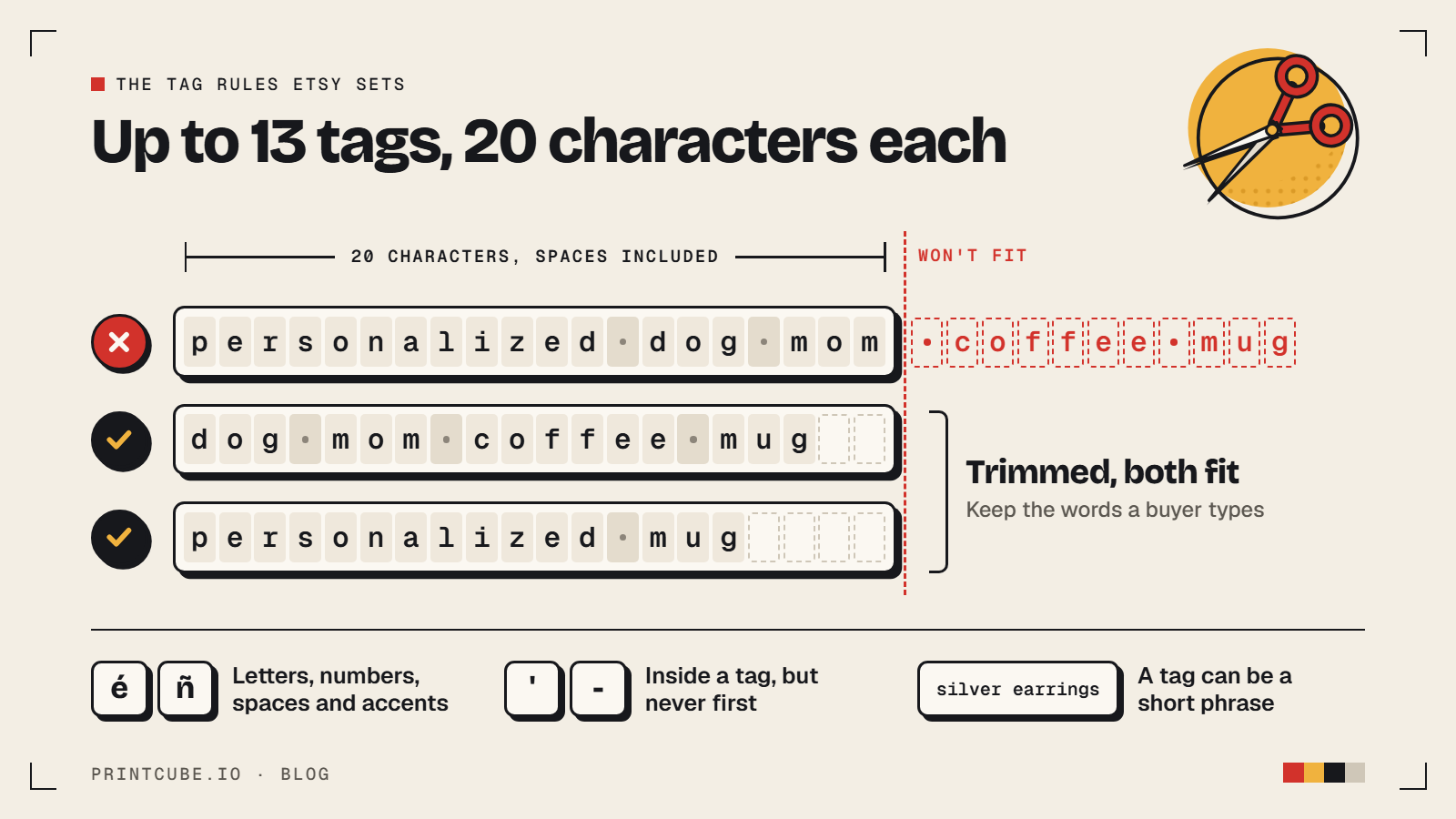
These are Etsy's rules:
- Up to 13 tags per listing.
- Each tag can be up to 20 characters, spaces included.
- Tags can use letters, numbers, spaces and accented Latin letters like é or ñ.
- Apostrophes and hyphens are allowed inside a tag but can't start one.
- A tag can be a short phrase. Etsy's own examples are "silver earrings" and "minimalist jewelry."
Twenty characters goes quickly. "Personalized dog mom coffee mug" won't fit, so you'll often trim to something like "personalized mug" or "dog mom coffee mug."
Some other advice you'll see a lot is common seller habit, not Etsy policy:
- Plurals. Most sellers don't tag both "mug" and "mugs." It uses up a slot for very little gain.
- Misspellings. Most sellers skip these too. They look careless, and you only have 13 slots.
- Repeating your title. The usual approach is to repeat your single most important phrase as a tag and use the rest for new angles.
You can ignore any of these if your own Stats suggest otherwise. They're habits that make sense for most shops, not requirements.
Picking phrases buyers type
Think about the person shopping. Someone searching just "mug" gets thousands of results and is probably only browsing. Someone searching "dog mom mug" knows what they want, and there's far less competition for that search. Your small shop has a much better chance of appearing in the second group of results.
Specific phrases also bring in shoppers who are closer to buying. A person typing "gift for dog mom" usually has a birthday or holiday coming up.
To spread your 13 tags well, go through these angles:
- Product type: what it is, in a couple of words ("plant dad shirt")
- Design or theme: what's printed on it ("monstera shirt," "retro plant tee")
- Recipient: who gets it ("gift for gardener," "gift for him")
- Occasion: why they're buying ("fathers day gift," "new puppy gift")
- Style: the look or tone ("funny gardening tee," "botanical shirt")
- Synonyms: other names buyers use ("tee," "tshirt," "shirt")
You won't use every angle equally. A gift-heavy design leans toward recipient and occasion tags. A design people buy for themselves leans toward style and theme.
Finding the words with Etsy's own tools
You don't need to pay for anything to find good phrases. Start with these three free sources.
The search bar. Type the start of a phrase into Etsy's search, like "plant dad," and look at the suggestions that drop down. Those suggestions come from real searches, so they're a good place to start.
Marketplace Insights. Find it in Shop Manager under Stats. Enter a keyword and it shows how many Etsy searches that phrase got over the last 30 days and how many listings compete for it. Look for phrases with plenty of searches but not an overwhelming number of listings. It also shows top searches in your categories, related searches with fewer listings, and trending searches. You get 15 keyword searches a week for free.
Your own Stats. Once a listing has been live for a while, Etsy Stats shows which searches brought people to it. Those are phrases you know work for your shop, and they often suggest tags for similar designs.
Paid keyword tools exist, and some sellers like them, but they aren't necessary when you're starting out. Etsy's own data covers the basics.
Example tags for a retro "Plant Dad" t-shirt
Say you've designed a retro-style "Plant Dad" graphic and put it on a tee through your print partner. The category is set to t-shirts, and the attributes already cover color, size and material. Here are 13 tags:
plant dad shirt · plant lover gift · houseplant tshirt · gift for gardener · crazy plant guy · retro plant tee · fathers day gift · botanical shirt · plant daddy tee · gift for him · monstera shirt · plant parent gift · funny gardening tee
Here's what each one covers:
- Product type: plant dad shirt, plant daddy tee, houseplant tshirt
- Design and theme: monstera shirt, botanical shirt, crazy plant guy
- Recipient: gift for gardener, gift for him, plant lover gift, plant parent gift
- Occasion: fathers day gift
- Style: retro plant tee, funny gardening tee
Notice how "shirt," "tee" and "tshirt" all appear in different phrases. That covers the different words buyers use without spending a slot on each one alone.
Some words are left out on purpose. "Cotton," "black" and "unisex" are already in the attributes. "Graphic tee" is too broad to compete on. Each slot goes to a search where this particular design has a real chance of showing up.
Example tags for a personalized dog mom mug
Now take a mug printed with a dog illustration and the pet's name. Most buyers are shopping for a gift, often for someone else's dog, so the tags lean toward gifts:
dog mom mug · custom pet mug · personalized mug · dog lover gift · gift for dog mom · pet portrait mug · mothers day gift · dog name mug · fur mama coffee mug · new puppy gift · doodle mom mug · coffee mug for her · birthday gift dog
The personalization gets its own tags ("custom pet mug," "personalized mug," "dog name mug") because buyers search for it directly. Occasions show up three times, through Mother's Day, a new puppy and a birthday, because each one is a separate reason to buy. "Doodle mom mug" targets owners of one popular breed group. If your design suits a specific breed, a breed tag like that is worth a slot.
"Ceramic," "white" and "11 oz" are left out. Put those in attributes or the description, where buyers checking details will see them.
Tag mistakes that keep listings hidden
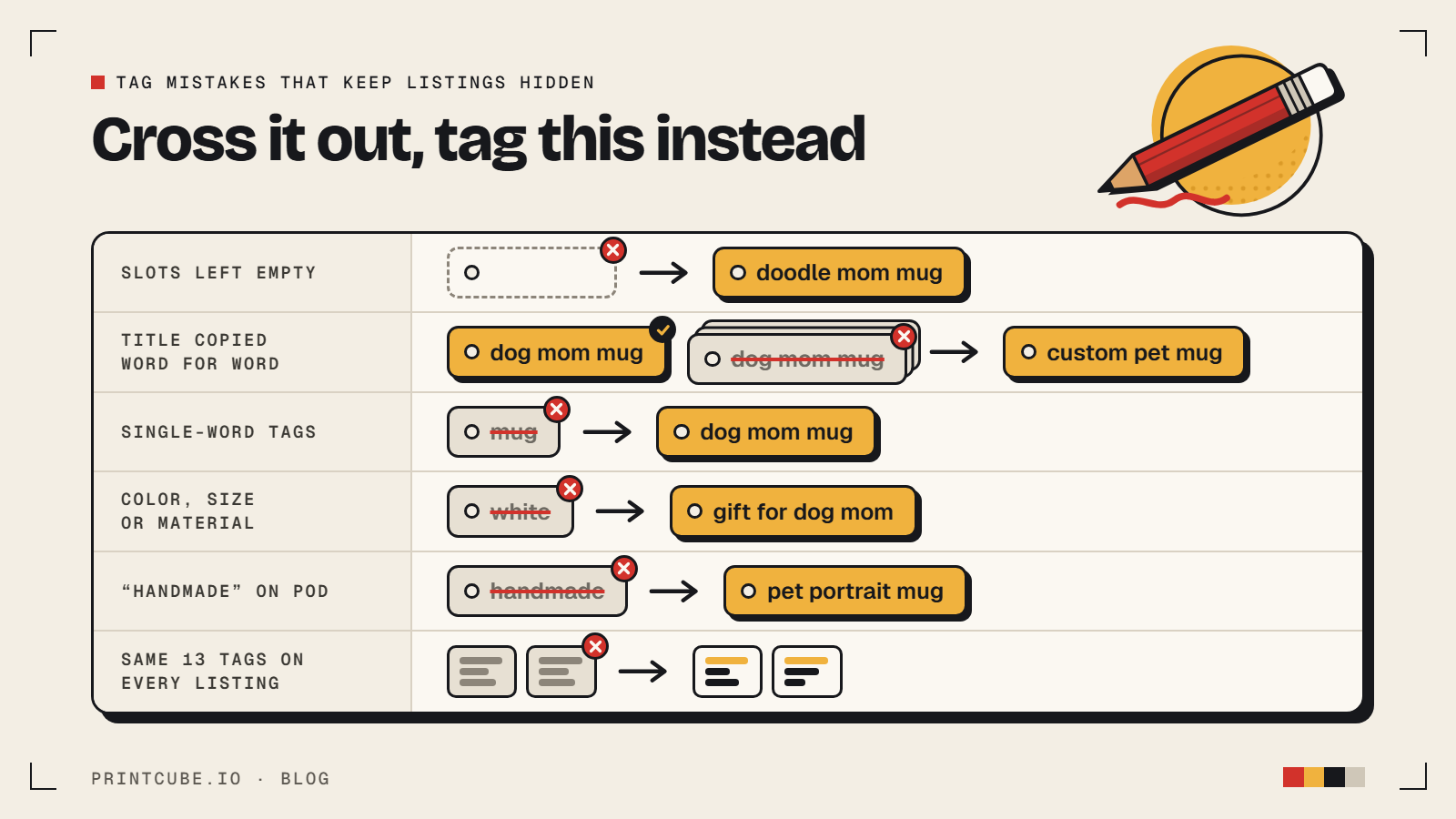
If you already have listings, open a few and check them against this table.
| Mistake | Why it hurts | What to do instead |
|---|---|---|
| Leaving tag slots empty | Each empty slot is a search you can't match | Fill all 13, even if the last few are narrower phrases |
| Copying the title word for word into tags | You're covering the same search several times and missing others | Repeat your main phrase once, then add new angles |
| Single-word tags like "mug" or "shirt" | You compete with a huge number of listings for vague searches | Use phrases like "dog mom mug" |
| Tagging color, size or material | These are wasted slots when attributes already cover them | Fill in attributes, use tags for recipient and occasion |
| Tagging "handmade" on POD products | It's inaccurate, and it misleads buyers about how the item is made | Describe the design and buyer instead, and disclose your production partner |
| Same 13 tags on every listing | Your listings compete with each other for identical searches | Keep a few shared tags and customize the rest per design |
The "handmade" one deserves extra care. Etsy expects tags to be accurate, and print on demand sellers are expected to list their production partner. A buyer who feels misled can leave a bad review or open a case, and that costs a small shop much more than a missing tag would.
When to rewrite your tags, and how long to wait
Before you change anything, look at your data. Go to Etsy Stats, then "How shoppers found you," then Etsy search. You'll see which search terms brought visitors to your shop. The data refreshes a few times a day.
What you find there tells you where the problem is.
Low views usually means a search problem. Either your tags and title don't match what people type, or you're competing for searches that are too crowded. This is the case where rewriting tags makes sense.
Views but few sales points somewhere else. People are finding the listing and leaving. That's usually the photo, the price, the shipping cost or the design. New tags won't fix it.
When you rewrite, change three or four tags at a time instead of all 13. Keep any that already appear in your search terms. Then give it a few weeks before you judge, because a listing needs time and traffic before the numbers mean much. If you change everything at once, you won't know which change helped.
You may also see two Etsy tools in Shop Manager. The Search Visibility page checks your listings against criteria for priority placement, such as a clear main photo of one finished product, a specific category, a return policy and, for US listings, domestic shipping under $6. These checks change from time to time, so read what the page shows for your shop. If you see an Update titles option, Etsy will suggest new titles. Download a CSV of your listings first, then move any useful keywords from your old titles into tags, descriptions or attributes. Changes can take up to a day to appear.
How much effort tags are worth
Tags deserve a careful first pass and an occasional check, not hours of fiddling. A good tag set helps the right buyer find your listing. It can't create demand for a design nobody wants, and it can't make up for a blurry mockup or a price $8 higher than the shop next to you.
Here's how I'd rank them. Design comes first, because it's what people pay for. Photos come second, since they decide whether anyone clicks. Price and shipping come third. Tags come right after those, as the piece that gets your listing in front of shoppers in the first place.
For a new POD shop, that means about ten focused minutes per listing: fix the synced fields, fill in the attributes, and write 13 phrases that cover different angles. Then put your energy back into designs, and use your Stats to decide which tags to adjust later.
FAQ
Do I have to use all 13 tags?
Etsy doesn't require it, but there's no reason to leave slots empty. Each tag is another search your listing can match, so fill them all.
Should my tags repeat my title?
Repeat your main phrase once as a tag. Etsy already reads your title, so use the other tags for recipients, occasions and synonyms the title doesn't cover.
How long after changing tags will I see a difference?
Edits save right away, but give it a few weeks before deciding whether a change worked. A listing needs enough traffic for the numbers in Etsy Stats to mean anything.
Can I use the same tags on all my listings?
A few shared tags are fine, like "plant lover gift" across a plant-themed collection. Most tags should match the specific design, or your own listings end up competing for the same searches.
Should I tag "handmade" on print on demand products?
No. A print partner makes the item, so "handmade" isn't accurate. Describe the design and who it's for instead, and list your production partner on the listing.