
If you're choosing between the big print-on-demand services, Gelato is a good pick for one kind of seller in particular: someone whose buyers are scattered across several countries and who sells fairly standard products like tees and wall art. It costs nothing to start, and the paid plan is optional. If all your buyers live in one country, or you want unusual products and lots of branding extras, the case for Gelato gets weaker and Printify or Printful may suit you better.
Is Gelato print on demand a good fit for a small seller?
For a lot of small sellers, yes. You can install it for free, connect a store, and pay only when an order comes in. There's no minimum and no inventory.
What decides it is where your customers are. Gelato's whole pitch is printing close to the buyer. If you're a US seller with a Shopify store and you expect orders from the UK, Germany, Canada and Australia, that pitch is aimed at you. If you expect 95% of your orders to come from the same country you live in, almost every service can print domestically for you, and Gelato's main advantage shrinks to "one of several fine options."
So I'd lean toward Gelato if your audience is international, or if you don't know yet where it'll be and want to keep that door open. I'd look harder at the alternatives if you're selling in one country and care most about catalog variety or custom packaging.
How Gelato prints an order near your buyer
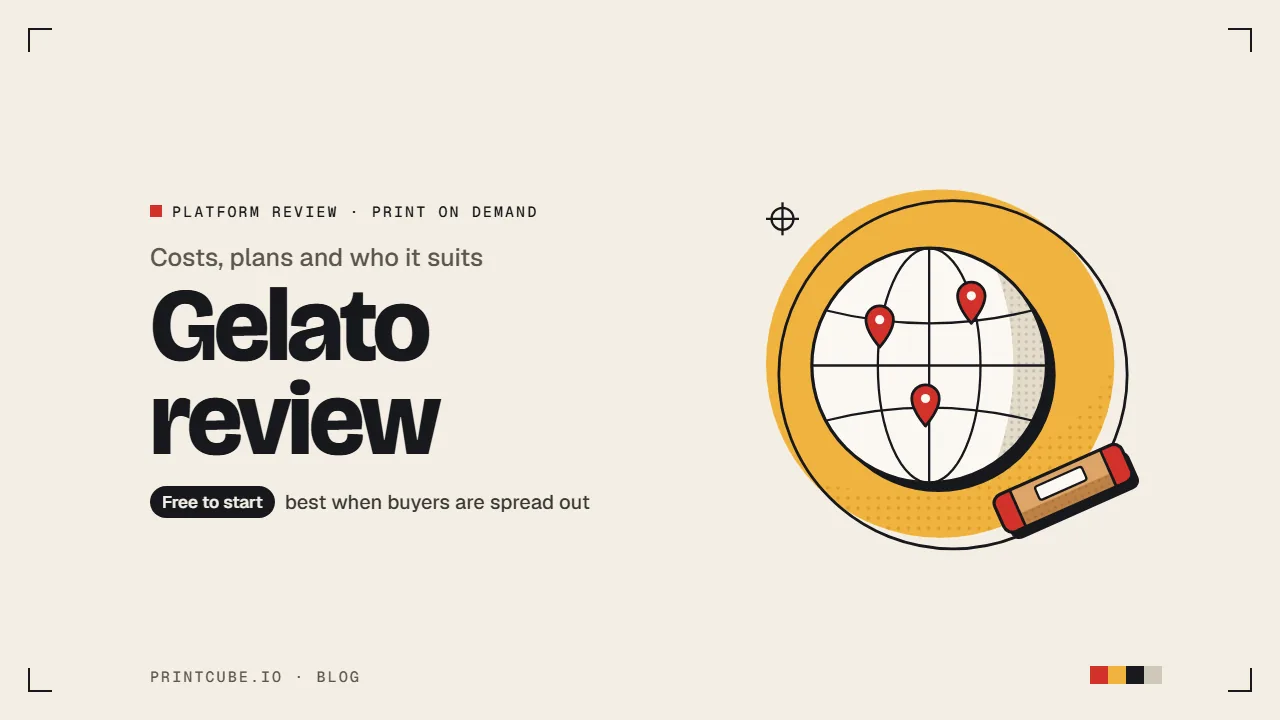
Gelato doesn't run one big factory. It works with more than 250 production partners spread across 32 countries. When an order comes in, it gets sent to a partner close to the delivery address, and that partner prints and ships it.
Say you sell a poster to someone in Munich. Instead of printing it in the US and flying it across the Atlantic, the order goes to a partner in or near Germany. The package travels a shorter distance and, in most cases, doesn't cross a customs border. The idea is that this makes delivery quicker and cheaper, and spares your buyer a surprise import bill.
That's the intent, and it's a sensible one, but treat it as a design goal and not a promise for every order. Not every partner makes every product, so a particular item might be printed farther away than you'd expect. Before you rely on it, check the shipping rates and delivery estimates for the specific products and countries you care about.
It also has a flip side: your orders are printed by different companies depending on where the buyer lives. That matters for quality, which I'll get to further down.
What a t-shirt and a poster cost you once shipping is added
Three numbers decide what you keep on an order, and you can see all of them before you sell anything.
- Base price. What Gelato charges you to make the product. It's shown on each product in the catalog and changes with the shirt model, the size and color, and, for posters, the paper and dimensions.
- First-item shipping. What it costs to ship one item to a given country.
- Additional-item shipping. A smaller charge for each extra item in the same order.
Prices differ by product and by destination, so look up the exact tee and poster you plan to sell, with the destination set to the country where most of your buyers live. Write the three numbers down for each.
Here's how the math works, using what Gelato's own price calculator showed for a US delivery at the time of writing.
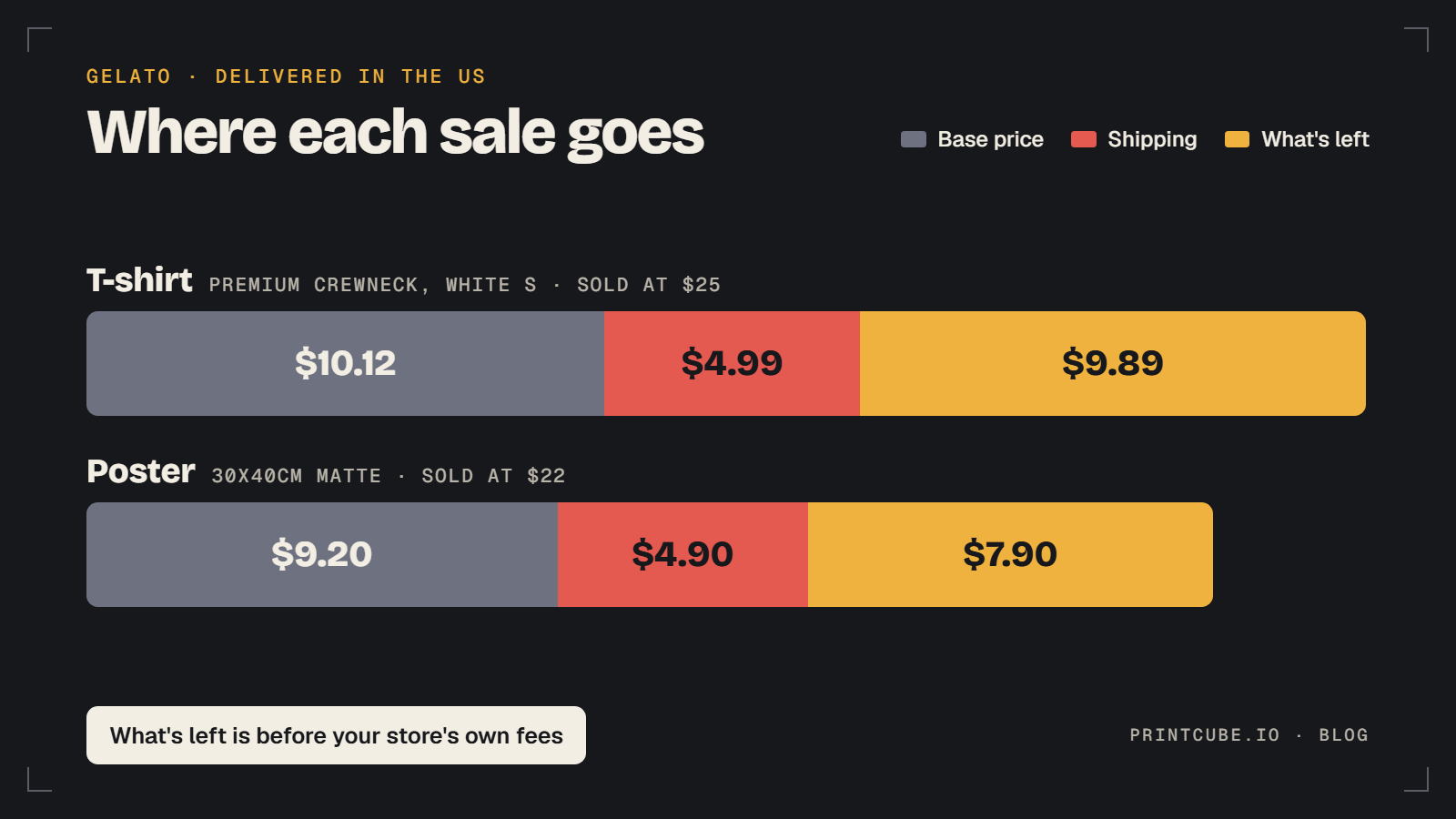
Its Premium Unisex Crewneck T-shirt, in white and size S, had a base price of $10.12, first-item shipping of $4.99 and additional-item shipping of $0.99. Say you sell it for $25 with free shipping.
- One tee: $25 minus $10.12 minus $4.99 leaves $9.89.
- Two tees in one order: $50 minus $20.24 for the shirts, minus $4.99 for the first and $0.99 for the second, leaves $23.78.
Now the poster. A 30x40cm (12x16 inch) matte poster had a base price of $9.20 and shipping of $4.90. Sell it for $22 and that leaves $7.90.
Those leftovers aren't profit yet. Your store or marketplace takes its cut too: payment processing, plus listing and transaction fees if you sell on a marketplace. Subtract those and you have your real margin.
Notice how much of the cost is shipping. On that tee it's a third of what you pay. That's why sellers who charge shipping separately, or who nudge buyers toward two items per order, tend to keep more per sale. It's also why a discount on the base price only helps with part of your costs.
What Gelato+ costs and when it pays for itself
The free plan costs nothing to install. You pay production and shipping on each order and that's it.
Gelato+ is the paid plan most sellers would look at. (There's also Platinum, with custom pricing, for large sellers.) It's $29.99 a month, or $239.88 if you pay for a year up front. The yearly price works out to $19.99 a month, so you save $120 a year by committing. There's a 14-day free trial, and the current details are on Gelato's Shopify App Store listing.
For that you get up to 33% off products, plus a library of stock images and fonts and tools for making mockups, setting prices and migrating products over from another service.
Two things to keep in mind. "Up to 33%" means the discount varies by product, so your tee might get much less than the headline number. And the discount is on products. The plan doesn't list a shipping discount, so in the example above the $4.99 shipping stays $4.99.
To see if it's worth it, divide the monthly fee by what you save per item.
Suppose the discount on your tee comes to $2 a shirt (again, an invented figure). On monthly billing, $29.99 divided by $2 is about 15 shirts a month before the plan covers itself. On annual billing, $19.99 divided by $2 is about 10. Below that, you're paying more in fees than you're saving.
So work out your own number. Start the trial or check the discounted price on your products, find the real saving per item, and do the division. If you're selling three or four items a month, stay on the free plan. If you're steadily past your break-even, the plan starts earning its keep, and the annual price makes sense once you're confident those sales will continue.
The tools are a nice extra, but I wouldn't pay $29.99 a month for mockups alone when you're just starting.
Print quality when different partners print your orders
Because a different partner may print each order, a tee delivered in Texas and the same tee delivered in France probably didn't come off the same machine. They might not even be the exact same blank shirt. Small differences in color, print feel or paper finish between regions are a built-in possibility of this model.
That doesn't mean the quality is bad. It means you can't judge it from one order in one place and assume it holds everywhere.
The sensible move is to order samples before you launch. Order the exact products you'll list, with your real designs, to your own address. Check the colors against your screen, wash the shirt a few times, and look at how the poster is packaged. If a big share of your buyers will be in another country, it's worth sending a sample to a friend there and asking for photos.
A sample costs you one order's worth of money and can save you a batch of refunds.
Which stores Gelato connects to
Gelato has an official Shopify app and an official WooCommerce plugin. If your store runs on either, you install it, connect your account, and products you create in Gelato get pushed to your store. Orders flow back automatically for printing.
If you plan to sell somewhere else, Gelato's integrations page also lists Etsy, TikTok Shop, Amazon, Wix, Squarespace and BigCommerce. Read how orders sync for your exact channel before you build anything. Finding out after you've designed thirty products that your channel needs a workaround is no fun.
Things to check before you commit
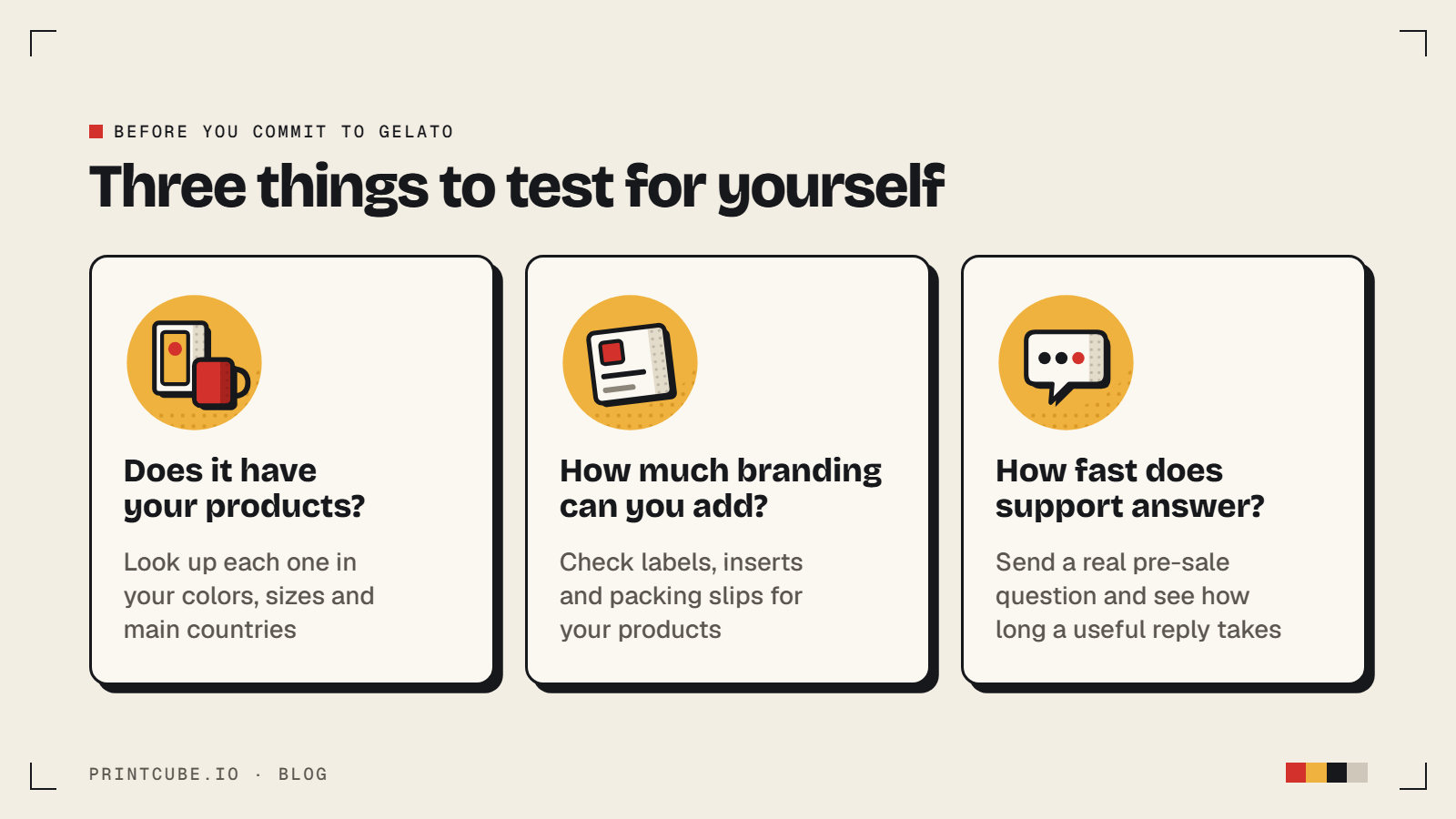
Three complaints come up often when sellers talk about Gelato. I'd treat them as questions to test for yourself, since your experience depends on what you sell and where.
Does it have the products you want?
Gelato's range is often described as smaller than its rivals'. That only matters if it's missing something you need. Write down the products you want to sell now and in six months, then check that each one exists in the colors and sizes you want, and that it's available in your main countries.
How much branding can you add?
If you want your logo on the packing slip, custom neck labels or inserts in the box, look at what's offered for your specific products. Sellers who care a lot about the unboxing sometimes find the options thinner than they hoped.
How fast does support answer?
Send a real pre-sale question before you sign up for anything paid and see how long a useful reply takes. When a buyer's order goes missing, that response time becomes your response time.
Gelato vs Printify vs Printful: which one suits you
The three services work differently, and that difference matters more than a dollar here or there on a base price.
| Gelato | Printify | Printful | |
|---|---|---|---|
| Who prints your order | A partner near the buyer, chosen by Gelato | A third-party print provider | Mostly Printful's own facilities |
| Who picks the printer | Gelato routes it automatically | You choose a provider, or let Printify Choice pick | Printful |
| Main appeal | Local printing in many countries | Wide choice of products and providers to compare | One company controlling production |
| Cost to start | Free plan, pay per order | Free plan, pay per order | Free plan, pay per order |
| Optional paid plan | Gelato+ at $29.99 a month or $239.88 a year | Premium at $39 a month or $299 a year | Growth at $24.99 a month |
Pick Gelato if your buyers are in several countries and you sell mainstream products. You don't have to think about where things get printed.
Pick Printify if you like comparing options and want control. You choose which provider makes each product, so you can shop around on price and location. The trade-off is that the choosing, and the quality checking, is on you. Its plans are on the Printify pricing page.
Pick Printful if you want one company handling most of the printing itself and you care about consistency and branding. Check the Printful pricing page for product costs and the Printful shipping page for rates to your buyers' countries.
Whichever way you lean, run the same exercise on all three: same tee, same poster, same destination, base price plus shipping. The cheapest one for your products and your buyers is often not the one you'd guess.
FAQ
Is Gelato free to use?
Yes. The free plan costs nothing to install and has no monthly fee. You pay the production and shipping cost each time a customer orders. It lets you connect 2 stores, and Gelato+ removes that limit.
Do I need Gelato+ from day one?
No. Start on the free plan and work out your saving per item first. With an invented $2 saving, you'd need about 15 items a month on monthly billing, or 10 on annual, before it pays for itself. The 14-day trial lets you see the real discounted prices on your products.
Should I order samples before I start selling?
Yes. Different partners print in different regions, so order your real products with your real designs and check them yourself. If you expect a lot of buyers in another country, send one there too.
Does Gelato work with Etsy?
Yes. Gelato's integrations page lists Etsy alongside Shopify, WooCommerce, TikTok Shop, Amazon, Wix, Squarespace and BigCommerce. Before you build your shop around it, read how listings and orders sync for Etsy in particular.
Does Gelato+ make shipping cheaper?
The plan lists a discount of up to 33% on products, not on shipping. Assume your shipping cost stays the same when you do your break-even math.