
Yes, Redbubble is legit. It's a real marketplace that prints your designs on products, ships them to buyers and pays you a cut. Joining costs nothing, and its fees only ever come out of money you've earned, so you can't end up owing it anything.
Legit and well-paid are different things, though. What you keep on each sale depends on an account tier that Redbubble picks for you, and for most new sellers that tier takes half.
Is Redbubble Legit for Sellers? Yes, and Here's the Catch
Nothing about Redbubble works like a scam. There's no signup fee, no monthly plan and no inventory to buy. If you never sell anything, you never pay anything. When you do sell, the fees are deducted from that sale's earnings before the rest goes to you.
The catch is the size of those deductions. A new seller at the default settings can expect about a dollar on a typical sale, and you can't pay or work your way out of that with volume alone. So the real question is whether the pay is worth your weekend of uploading.
If you're here as a buyer: orders are real, they get printed and they get delivered. Products are made by different third-party manufacturers, so read Redbubble's own returns policy before you order. That way you'll know your options if something arrives wrong.
How Selling on Redbubble Works
You open an account, upload a design, and choose which products it appears on: shirts, stickers, mugs, posters and so on. For each product you set a markup, which is your slice on top of what the product costs to make and sell.
After that, you're mostly done. When a shopper buys, Redbubble passes the order to one of its third-party manufacturers, who prints and ships it. Redbubble also handles the customer service, so a late parcel or a misprint lands in its inbox, not yours.
Your side of the work is the designs, the titles, the tags and the descriptions. The shoppers are already on the site browsing, which is the big draw for someone with no audience.
Being that hands-off has a price, and it shows up in the per-sale math.
What You Earn Per Sale
Every product has a base price. That covers the manufacturer's cost plus Redbubble's own service fee, and it can shift a bit depending on where the order is being delivered.
Your markup is a percentage of that base price. It starts at 10% unless you change it, and you can raise or lower it whenever you like. The shopper pays the base price plus your margin.
Say you've got a t-shirt design and the base price for that order is $20. At the default 10% markup, your margin is $2, and the shopper pays $22.
That $2 isn't what reaches you, though. First your account tier takes its share.
Account Tiers and the Fees They Take
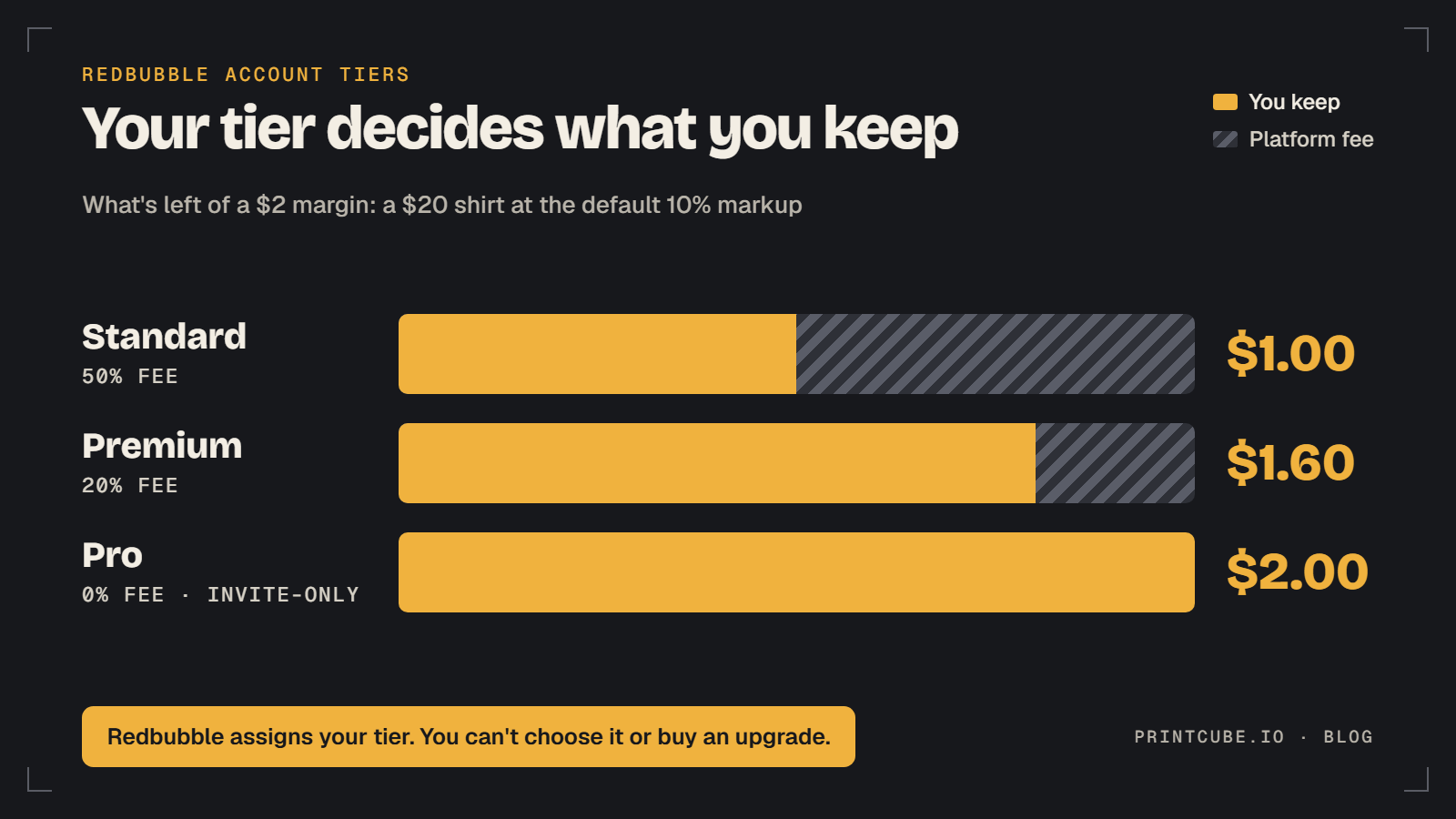
Redbubble sorts every seller into one of three tiers, and each tier pays a different platform fee on its earnings.
| Tier | Platform fee on earnings | Excess markup fee | How you get it |
|---|---|---|---|
| Standard | 50% | Yes | Assigned by Redbubble |
| Premium | 20% | Yes | Assigned by Redbubble |
| Pro | 0% | No | Invite-only |
Back to the $20 shirt with its $2 margin:
- Standard: you keep $1.00.
- Premium: you keep $1.60.
- Pro: you keep the full $2.
You don't choose your tier and you can't buy an upgrade. Redbubble assigns it based on things like:
- whether the artwork is original
- the quality of your files
- how appealing the work is to shoppers
- how accurate your tags and descriptions are
Sales volume isn't one of the factors, and Redbubble doesn't publish the full list. Pro is by invitation only, reserved for the top 1% of artists by performance and engagement, and picked once a year.
So if you're just starting, plan on Standard. If you land in Premium, great, but do your math on the 50% figure so nothing surprises you later.
The natural reaction is "fine, I'll just set a higher markup." You can, but there's a second fee waiting for that.
Why Raising Your Markup Past 20% Helps Less Than It Looks
Standard and Premium accounts pay something called an excess markup fee. On any product where your markup is above 20%, Redbubble deducts half of the earnings above that 20% line.
Take the same $20 shirt. At a 20% markup your margin is $4. Push it to 30% and your margin becomes $6, so it looks like you've given yourself an extra $2 per sale. Half of that extra $2 goes to the excess markup fee. The shopper pays $2 more, and only $1 of it counts toward your earnings.
This fee is separate from the platform fee your tier already charges. Pro accounts are exempt from it.
Meanwhile, the higher price makes your shirt look expensive next to similar designs on the same search page. Going up to 20% is a reasonable move for a lot of sellers. Beyond that, you're asking buyers to pay more for a gain you only get half of.
Getting Paid: The Payout Threshold and the Fee Cap
Redbubble pays out once your earnings, after account fees, reach $10 (or £10 or €10, depending on your currency). Below that, the money sits in your account and rolls forward until you cross the line.
For a Standard seller making about a dollar a sale, that's roughly ten sales before the first payout. It's not a high bar, but with a handful of designs it can take a while.
There's also a ceiling on fees. Your total account fees can't go over $150 (or €150 or £150) in a single payment period. Once you hit that, the rest of your margin for the period is yours.
On platform fees alone, a Standard account reaches the cap at $300 of margin in a period, and a Premium account at $750. If your shop is small, you won't get near it. If you have a design that takes off, the 50% cut stops hurting past that point.
What Sellers and Buyers Complain About
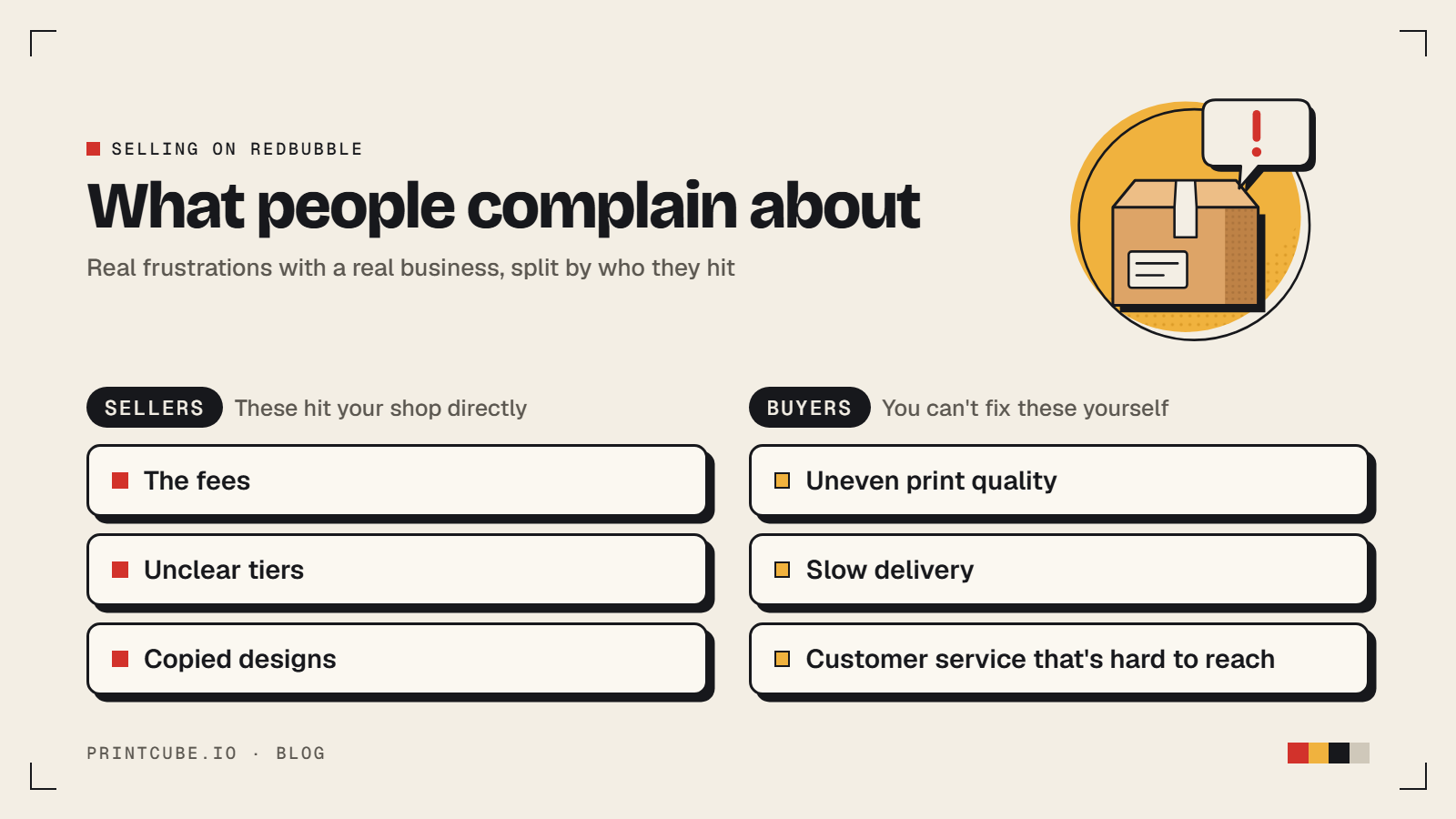
The complaints you'll read about Redbubble are mostly about a real business being frustrating, not about fraud. Some of them matter to you as a seller and some mostly don't.
The ones that hit sellers directly
The fees. Sellers who see a payout that's half what they expected often feel cheated. Usually they're on Standard and didn't realize it.
Unclear tiers. Because Redbubble doesn't disclose everything that goes into tier assignment, sellers say they can't tell what would move them up. If you like knowing the rules, that's a fair thing to be annoyed about.
Copied designs. Artists report finding their work re-uploaded by other accounts. On an open marketplace this is a risk for anyone with a design that sells.
The ones that come from buyers
Buyers complain about uneven print quality, slow delivery and customer service that's hard to reach. With many different manufacturers involved, some inconsistency is to be expected.
You don't deal with these directly, since Redbubble handles support. But you also can't fix them. You don't pick the printer, you can't order a replacement yourself, and you can't reach the customer to make it right. If control over the buyer's experience matters to you, that's a real limitation.
When Your Own Store on Printify or Gelato Earns More
Printify and Gelato work differently. They're print providers you connect to a store you run yourself. An order comes in on your storefront, they print and ship it, and they charge you the product cost.
That changes the math in your favor per sale. You set the retail price and you keep the whole gap between it and what the product and shipping cost you. Nobody takes half your margin and no fee kicks in above a certain markup.
Here's an example with made-up numbers. Suppose a shirt costs you $13 all in and you sell it for $25. Before your other costs, that's $12, against the $1 a Standard seller keeps on the Redbubble shirt above.
The "before your other costs" is where it gets harder:
- You find the buyers. There are no shoppers browsing. Every visitor comes from your own social posts, ads, search traffic or a marketplace listing you pay for.
- You pay for the storefront. Selling platforms and marketplaces have their own fees, and the print provider may have paid plans. You can see what Printify charges on its pricing page.
- You handle customer service. The "where's my order" emails and the misprint complaints come to you.
- You can lose money. Spend on ads or subscriptions without sales and you're out of pocket, which can't happen on Redbubble.
So your own store earns more when you can bring your own traffic. If you already have a following, a niche community you're part of, or the patience to learn marketing, the per-sale difference adds up fast. If you have none of that, a big margin on zero sales is still zero.
So, Should You Sell on Redbubble?
I'd treat Redbubble as a free testing ground more than a paycheck.
It suits you if you're brand new, have designs but no audience, and want to see whether strangers will buy your work without spending a cent. A dollar a sale is thin, but it shows you which designs people want. It also suits you if you only want to make art and never answer a customer email.
Skip it, or don't lean on it, if you already have people who'd buy from you. Sending your own followers to Redbubble means handing over half the margin on sales you created yourself. Put those buyers through a store on Printify or Gelato.
Doing both makes sense for a lot of sellers. Upload to Redbubble, watch what gets views and sales, then build your own store around the designs that proved themselves. Neither path comes with promised earnings, but that order lets you learn before you risk any money.
FAQ
Can you ever owe Redbubble money?
No. There's no cost to join or list, and account fees are only deducted from earnings when a sale happens. With no sales, there are no fees.
Can you upgrade your Redbubble account tier?
Not by paying or applying. Redbubble assigns tiers itself. The things you can control are the ones it looks at: original artwork, good-quality files, and accurate tags and descriptions. Pro is invite-only and chosen annually.
What's the minimum payout on Redbubble?
$10, £10 or €10 after account fees. Earnings below that carry over until you reach it.
Is the 50% fee taken from the full sale price?
No, only from your earnings. On a $20 base price with a 10% markup, the fee applies to your $2 margin, not the $22 the shopper pays.
Is Redbubble safe to buy from?
Yes, it's a real store that prints and delivers orders. Quality and delivery times can vary because different manufacturers make the products, so check Redbubble's returns policy before you order.