
If you have a handful of designs and no audience, Amazon Merch on Demand is still worth applying to. It costs nothing, and Amazon already has the shoppers you don't. Just go in expecting a modest cut per shirt, not most of the price, because Amazon sets the math that decides what you keep.
Is Amazon Merch on Demand still worth it for a new seller?
Yes, as a first step, and with clear eyes about the trade. You upload artwork and pick the product type and colors. Amazon builds the product page, prints the shirt when someone orders, ships it, and deals with customer service. You get a royalty on each sale.
What Amazon gets in return is control. It decides how the royalty is worked out, how many designs you can have live, and what's allowed. And you never find out who bought your shirt.
For someone with ten designs and no following, that's a fair deal. The thing you lack is shoppers, and that's what Amazon is offering. It becomes a worse deal once you have your own audience.
What it costs to join and how the application works
The account is free. Amazon describes it as having no out-of-pocket cost: you don't pay to join, and you don't buy stock. If nothing sells, the only thing you've lost is time.
Signing up doesn't let you start uploading straight away, though. You sign up with an Amazon account, fill in details about yourself, and wait for Amazon to review your application. Amazon says applications are typically processed within 14 days, but don't plan a launch around a date. Use the wait to get your designs ready.
Amazon doesn't owe anyone an explanation for a no, so the best you can do is give it no easy reason:
- Fill in every field properly. Use your real name and real details.
- Have your bank details ready. In the US, Amazon pays royalties by electronic transfer once a month, about 30 days after the end of the month in which the shirt shipped.
- Say plainly what you plan to make. If you have a portfolio or an existing shop, mention it.
A half-finished form helps nobody.
How tiers cap the number of designs you can upload
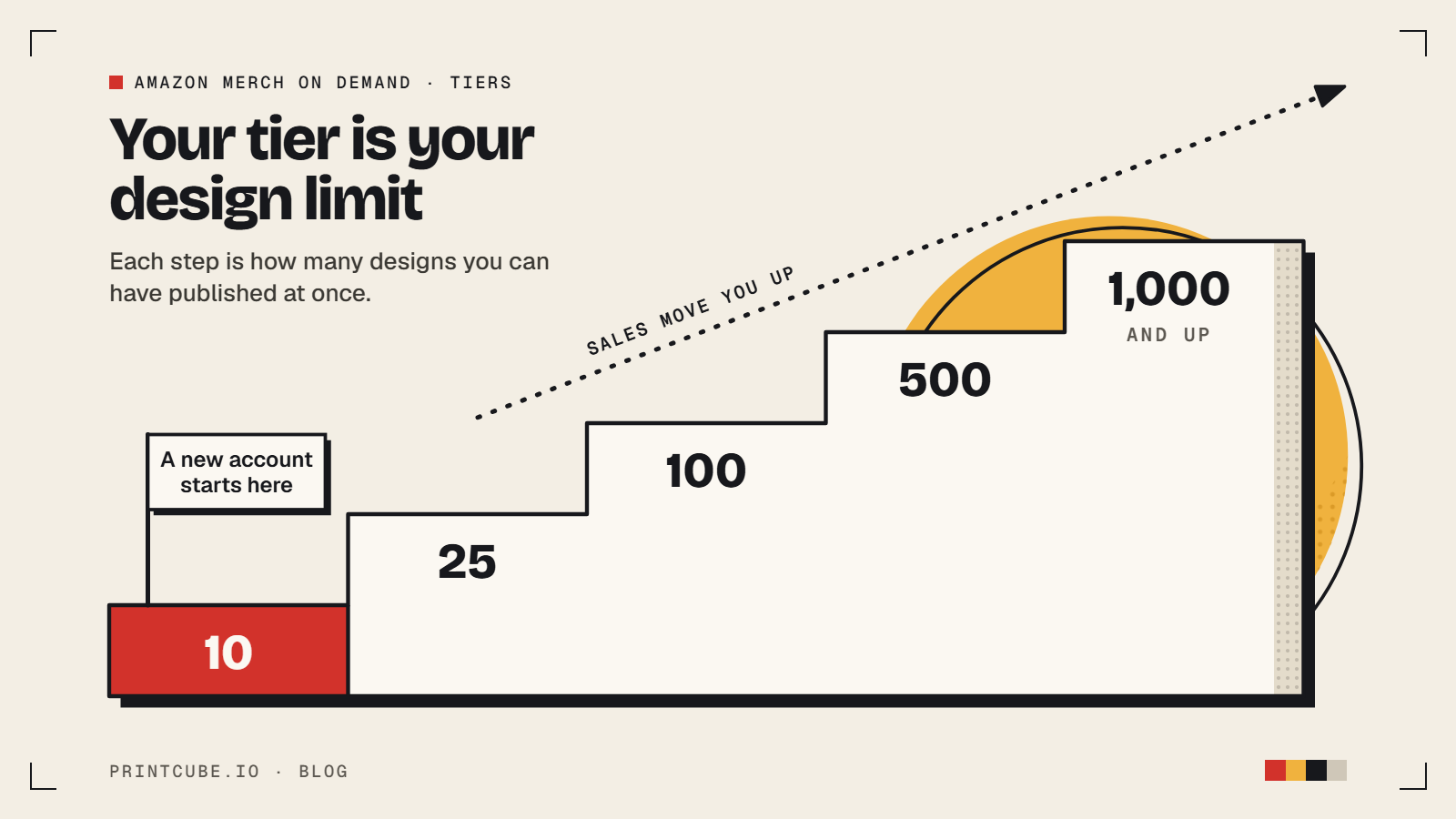
Getting approved doesn't mean you can upload everything you've got. A new account starts at Tier 10, which means 10 published designs at a time. The tiers go 10, 25, 100, 500, 1,000 and up, and Amazon works out yours from how many of your designs and products sold over the last 12 months. Your dashboard shows your tier, plus a second limit on how many products you can submit each day.
Suppose you have ten designs ready and twenty more sketched out. With ten slots, you can't throw all thirty at the wall and see what sticks. Each slot has to be used on something you think will sell. One thing helps: a design counts once against your tier, however many products and countries you put it on.
So it pays to be picky early on. Lead with your strongest ideas. If a design sits there for weeks doing nothing, consider swapping it out, because more slots only come from sales.
It's a slow start by design. Some people find that frustrating; others like being forced to focus.
What a t-shirt earns at different list prices
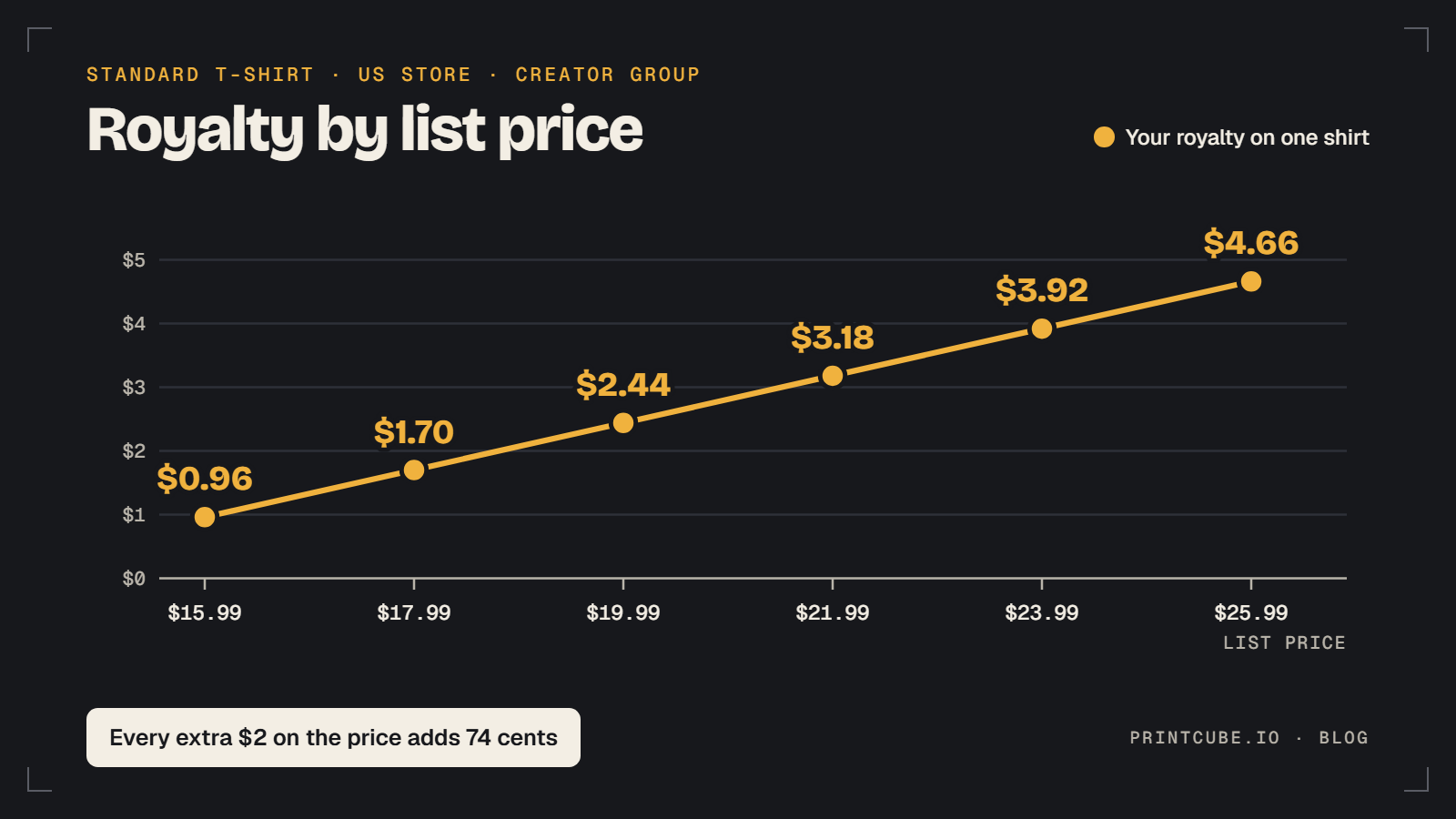
Amazon's rule is simple to state: your royalty is the price the shopper pays, less any applicable tax, less Amazon's costs, with a multiplier for your royalty group on top. You choose the list price. Amazon decides what its costs are.
Amazon publishes example royalties for a standard t-shirt in its US store. These are for the Creator group, where a new account sits:
| Your list price | Your royalty |
|---|---|
| $15.99 | $0.96 |
| $17.99 | $1.70 |
| $19.99 | $2.44 |
| $21.99 | $3.18 |
| $23.99 | $3.92 |
| $25.99 | $4.66 |
Look at how fast your cut moves. Going from $15.99 to $19.99 adds $4 to the price and more than doubles what you keep. Every extra $2 on the price adds 74 cents to your royalty.
Then there's the multiplier. For US sales, Amazon sorts sellers into three royalty groups by how much of their sales they bring in themselves, through ads or social media:
- Creator: the standard rates in the table.
- Plus: twice the Creator rate, if you drive at least 15% of your unit sales.
- Premium: 2.16 times the Creator rate, if you drive at least 35%.
You need at least 10 sales a month in the US store to qualify for Plus or Premium, and Amazon updates your group every month. So the same $19.99 shirt pays $2.44 on Creator and $4.88 on Plus.
One caution before you price everything at the top: higher prices sell fewer shirts. Your shirt sits next to thousands of others, and plenty of them are cheaper.
Before you set a price, open the royalty table in your account. It shows what each price pays for each product. Check it again now and then, because Amazon can change it.
Content rules, rejections and the risk to your account
Every design is reviewed before it goes live, and trademark and copyright cause the most trouble for new sellers. Reviewers look at the words in your title and description too, not only the artwork.
These are the usual traps:
- Brand names and logos, even as a joke or a parody.
- Characters from films, shows, games and comics.
- Sports teams and leagues.
- Song lyrics and quotes from films or shows.
- Trademarked phrases. Plenty of ordinary-sounding sayings are registered for clothing, so search the trademark database before you build a design around a catchy line.
AI-made art gets no special pass on any of this. If the tool gives you something that looks like a famous character, that's your problem, not the tool's. Amazon's content policy has no separate rule for AI art at the time of writing, so the same rules apply to it as to anything else. Treat whatever you generate as your responsibility.
How much risk does a rejection carry? It's Amazon's platform, so Amazon decides what stays up and who keeps an account. Its content policy says breaking the rules can mean removed listings, a suspended or closed account, and withheld payments. You have no customer list and no store of your own to fall back on. So treat every rejection as something to learn from, not a cost of doing business. Fix the cause before the next upload, and don't resubmit the same idea with a small tweak.
Products and marketplaces beyond US t-shirts
T-shirts are where nearly everyone starts, but they aren't the only option. When you upload, you choose from the product types and colors Amazon offers. That covers other clothing and some non-clothing items. The same artwork can also be offered in Amazon's stores outside the US.
Each product and each country has its own cost and royalty figures. A price that works on a US t-shirt won't automatically work elsewhere, so check the table for each one.
With limited slots, I'd get a few t-shirts selling first and spread out later.
The good and the bad of letting Amazon run the sale
The good side is easy to like:
- It's free. You pay nothing to join and hold no stock.
- The shoppers are already there. People search Amazon ready to buy.
- The chores are Amazon's. It handles printing, shipping, returns and customer questions.
The bad side is what you give up for that:
- Competition is heavy. Any niche you think of already has pages of shirts, so a generic design gets buried.
- The upload cap slows you down. You can't test many ideas at once.
- You have no brand and no customer list. The buyer sees Amazon, not you. You can't email them or tell them about your next design.
- Amazon sets the margin. You choose the price, but Amazon chooses the costs taken out of it and can revise them.
None of that is a reason to skip it. It's a reason not to make Amazon the only place your designs live.
Amazon Merch on Demand vs Redbubble vs your own store
Redbubble works differently on the money side. Each product has a base price, and you add a markup percentage on top. That markup is your margin. It defaults to 10%, and you can change it whenever you like. On a made-up base price of $20, the default gives you a $2 margin, and a 20% markup gives you $4 but costs the shopper more.
Redbubble then takes a platform fee out of that margin, depending on your account tier: 50% on Standard, 20% on Premium and nothing on Pro. So the $2 becomes $1 on Standard. Pro is invite-only, for the top 1% of artists. Low-effort, repetitive or unmodified stock designs and tag spamming put an account in Standard, so original work matters there.
Your own store, say on Shopify with a print provider connected, flips the trade. You control the prices, the branding and the customer list. But you pay for a Shopify plan, and nobody visits unless you bring them.
| Amazon Merch on Demand | Redbubble | Your own store | |
|---|---|---|---|
| Who brings the shoppers | Amazon | Redbubble | You |
| How your cut is set | Price minus tax and Amazon's costs, times your royalty group | Your markup % times the base price, less the tier's platform fee | You set prices over your provider's costs |
| Brand and customer contact | Amazon keeps both | Redbubble keeps the customer | Yours |
| Getting in | Apply and wait for approval | Open an account | Build and pay for a store |
| Your workload | Designs and listings | Designs and listings | Designs, store, marketing, support |
Which suits you depends on what you already have:
- Designs but no audience: apply to Amazon Merch on Demand and put the same work on Redbubble while you wait.
- An audience already, such as a social following or an email list: your own store makes more sense, because you supply the traffic and keep the customer.
- Not sure yet: start on the marketplaces, see which designs people buy, and open a store later with those.
That last route is what I'd suggest to most beginners. A store with no visitors teaches you nothing, and the marketplaces let you learn for free what sells.
FAQ
Does Amazon Merch on Demand cost anything?
No. The account is free and you never buy inventory. Amazon takes its costs out of each sale before paying your royalty.
How long does approval take?
Amazon says applications are typically processed within 14 days. Send a complete, honest application, then keep working on designs so you're ready when the answer comes.
Are AI designs allowed?
Amazon's content policy doesn't ban them, and at the time of writing it has no separate rule for AI art. Whatever tool you use, the design has to be free of other people's trademarks and copyrighted work, and that's on you.
Can I sell on Redbubble too?
Yes. They're separate accounts, and listing a design on one doesn't stop you from listing it on the other. Their content rules differ, so a design accepted on one can still be refused on the other.
What size should my artwork be?
Amazon says to build the file at 100% of the print dimensions and 300 DPI, save it as a PNG and keep it under 25MB. The dimensions differ by product, so download Amazon's template for the one you're making.