
Yes, TeePublic is legit. It's a real company that prints and ships real orders and pays its artists on a published schedule. That's a pretty low bar, though. If you're thinking about uploading designs, the better question is whether the deal it offers is a good one for you, and that depends on how much control you're willing to give up.
Is TeePublic a real company or a scam?
It's a real company, and you don't have to take anyone's word for it. There are three things you can check yourself:
- It has a known owner. There's a corporate parent behind it, not an anonymous storefront.
- It publishes a return policy. The policy has clear time limits and conditions.
- It publishes a payout schedule. Artists are told the date they'll be paid and how.
Scam sites don't tend to do any of those. That doesn't mean every order arrives perfect or every artist is happy with their cut. It means that when something goes wrong, there's a written policy and a company to hold to it.
Who owns TeePublic, and is it the same as Redbubble?
TeePublic was bought by Redbubble in 2018, and the parent group now goes by the name Articore. So the two sites are siblings, which is why you'll often see them mentioned together.
They aren't the same site, though. Each has its own:
- Accounts and shops. A shop on one doesn't appear on the other.
- Catalog. Designs are uploaded to each site separately.
- Pricing model. Redbubble lets artists set their own pricing. TeePublic runs on regular and sale prices, with a fixed artist cut for each.
That pricing difference matters more than the shared ownership, and it comes up again in the pay section below.
What the shirts are like: classic vs premium tee
Even if you never buy one yourself, your customers will, so it helps to know what lands on their doorstep.
The classic tee is the standard option, and it's what most buyers end up with. It's commonly described as an ordinary everyday cotton shirt. The premium tee costs more and is generally reported as softer, with a slimmer cut. Exact fabric and fit details are on each product page, and they're worth a look before you describe the shirts to your own followers.
Buyer opinions are mixed in a predictable way. Plenty of people are happy. The ones who aren't usually mention one of these:
- The fabric felt thinner than they expected.
- The fit ran smaller than their usual size.
- The print faded after a number of washes.
As for shrinking, cotton tees from any printer can tighten up a little in a hot wash or a hot dryer. The usual advice applies: check the size chart, size up if you're between sizes, wash cold and inside out, and dry on low heat.
What happens if an order goes wrong
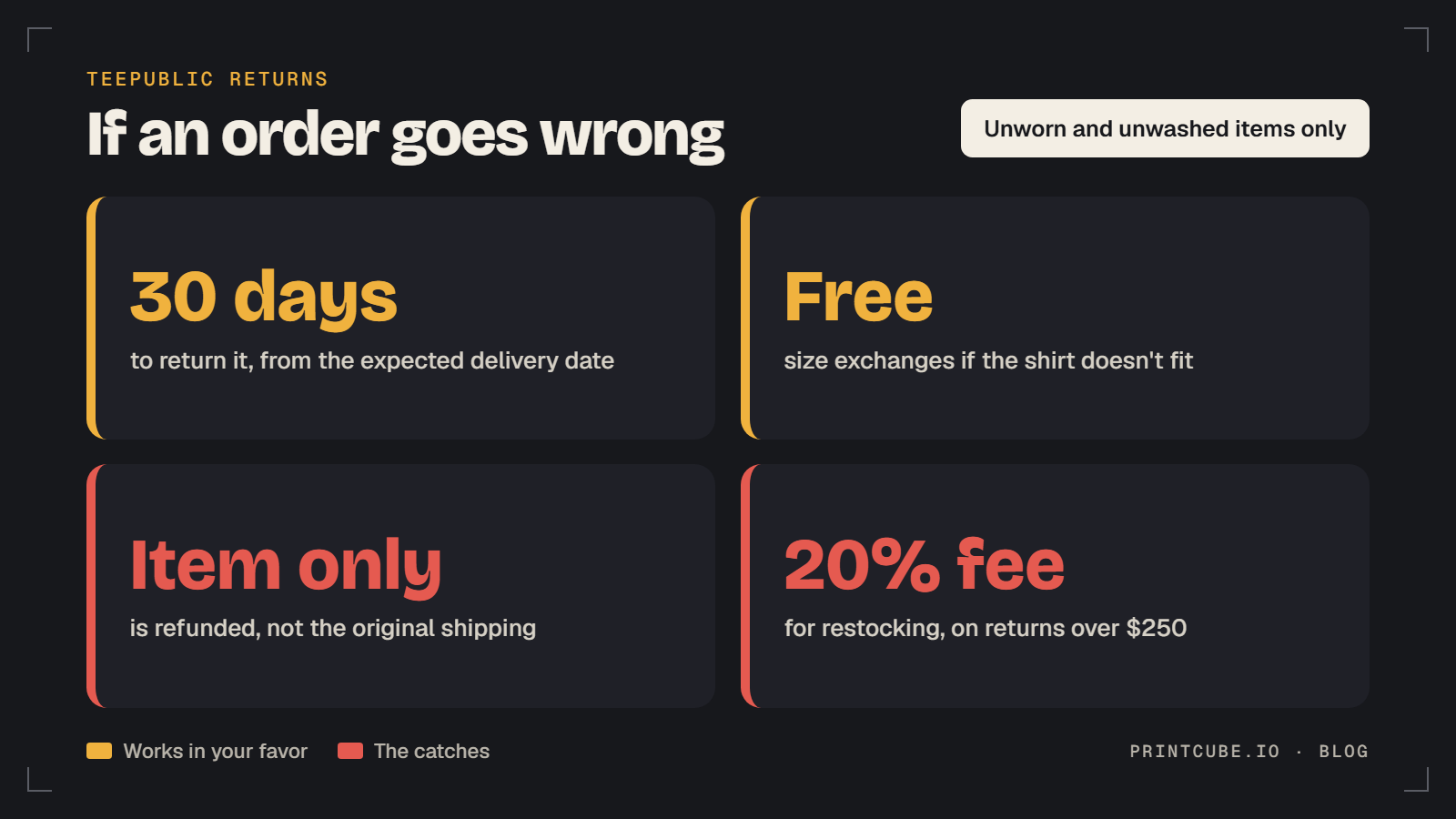
TeePublic's return policy is fairly generous for custom-printed products, with a few conditions:
- 30-day window. Returns are accepted within 30 days of the expected delivery date.
- Unworn and unwashed. Try it on, but don't wear it out or wash it if you might send it back.
- Free size exchanges. If the shirt doesn't fit, swapping it for another size costs nothing.
- Shipping isn't refunded. A refund covers the item, not what you originally paid for shipping.
- Restocking fee on big returns. Returns over $250 carry a 20% restocking fee. That won't touch someone buying a shirt or two, but it matters on a bulk order.
The free size exchange is the most useful part, since sizing is the most common gripe. That's reassuring for you as an artist too: a customer who gets the wrong fit has an easy fix that doesn't cost them anything.
Is TeePublic legit for artists? How the pay works
TeePublic does pay its artists. What catches new sellers off guard is how little say they have in the amount.
You don't set prices on TeePublic. The site decides what each product sells for, at a regular price and a sale price, and it decides what you earn at each. Your cut is a fixed amount per product, not a margin you choose.
That fixed amount drops in three situations:
- Site-wide sales. When TeePublic discounts everything, your earnings per item go down with the price.
- A design's first 72 hours. New uploads earn at the lower rate for their first three days on the site.
- Coupons and bundles. If the buyer uses either, you earn less on that order.
This is where the "why is my payout lower than I expected?" surprise comes from. Say you upload a design on Monday, share it with friends on Tuesday, and five of them buy. All five sales fall inside the 72-hour window, so all five pay the lower amount, even if there's no sale banner anywhere on the site.
TeePublic publishes the exact amounts on its earnings page. Look at the sale-price column as closely as the regular one, because you can't control which price your buyers pay.
Artisan, Apprentice and Pending: the label that decides your visibility
Every artist account sits in a category, and it affects two things: how much you earn per sale and whether shoppers can find you through TeePublic's own search.
Artisan accounts are eligible to appear in on-site search. They also get a discount on the fixed service fee TeePublic takes from each sale, so they earn more than Apprentice accounts on most products.
Apprentice accounts pay the full service fee and are not eligible for on-site search. Your shop still exists and your links still work, but someone browsing TeePublic for "retro cat shirt" won't come across your retro cat shirt.
Pending is where everyone starts after their first upload. Your shop is open and can make sales through your own links, but it doesn't show up in on-site search yet, and you earn at the Apprentice rate until TeePublic reviews you.
A few things about that review are useful to know before you upload anything.
What triggers the review
Completing your profile does. TeePublic recommends a profile image, a banner, a bio, social links and at least 10 designs to start the review, and says you'll hear back within 3 business days once they're in place.
What it's based on
TeePublic says the category comes down to design quality and approach, not sales volume. So you can't sell your way into Artisan. Those first 10 designs are your audition, and it makes sense to lead with your strongest, most original work instead of ten quick text designs.
Why you can't ask for an upgrade
TeePublic doesn't act on requests to move from Apprentice to Artisan. Emailing support won't change it.
This is the biggest risk in the whole arrangement. The reason to accept fixed prices and a fixed cut is that the marketplace brings shoppers to you. If you land in Apprentice, you've handed over the pricing and you're still bringing every customer yourself.
When and how TeePublic pays you
Payouts are simple. Earnings go out on the 15th of each month and cover sales from the previous calendar month. A shirt sold on March 3 is paid on April 15, and so is one sold on March 30.
You can be paid through PayPal or Payoneer, and those are the only two options. TeePublic's payout page doesn't mention a minimum amount you need to reach first.
If you're outside the US, there's one more cost to watch. When PayPal converts your earnings into your local currency, it charges its own conversion fee, and TeePublic says it has no control over that. Check what PayPal charges for conversion before you assume the whole amount will reach your bank.
Common complaints, and which ones should change your mind
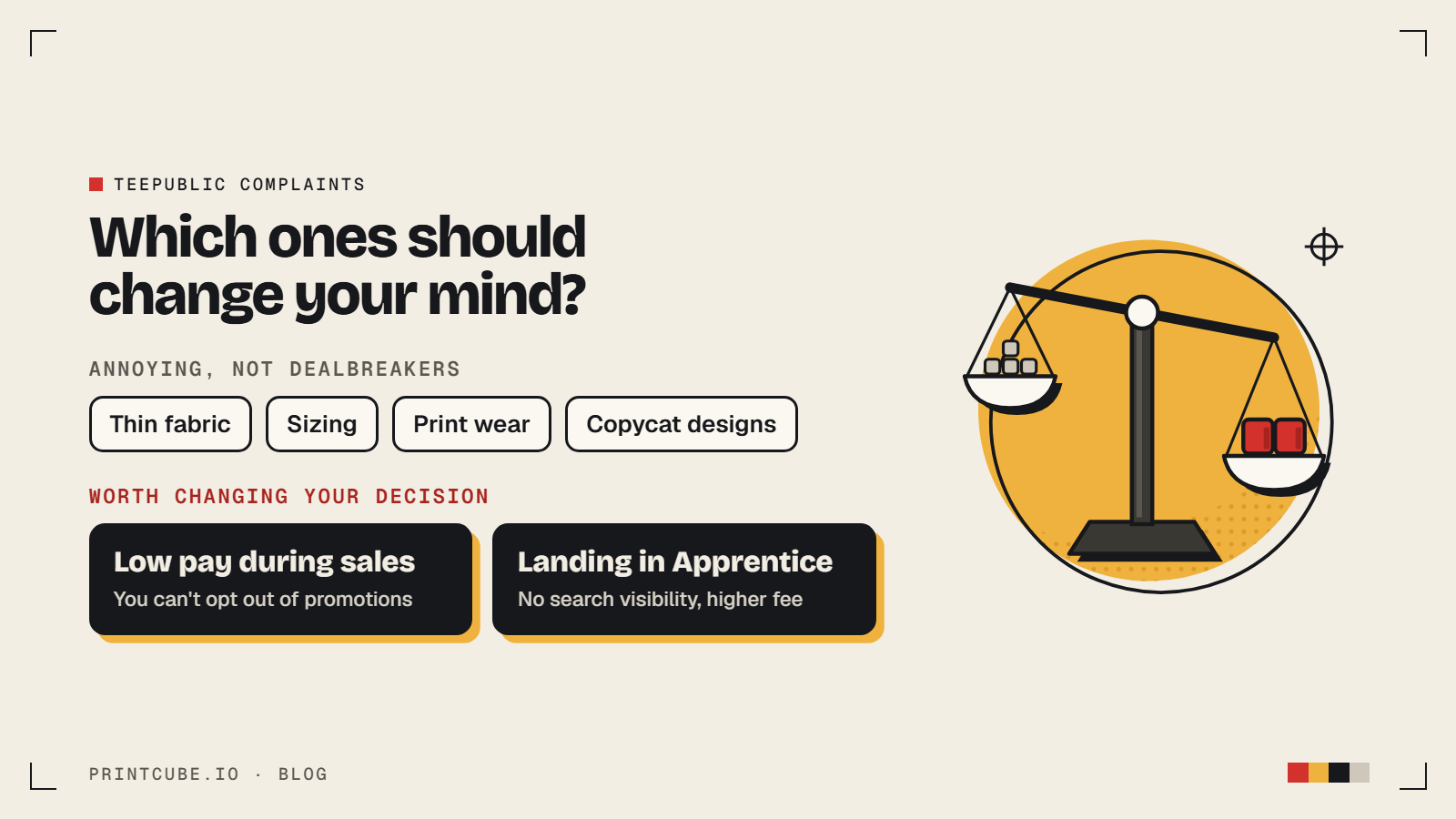
Not every complaint deserves equal weight. Some are just the normal friction of print on demand, and some should affect your decision.
Annoying, but not dealbreakers
Thin fabric, sizing and print wear. You'll find these complaints about nearly every print-on-demand shirt, because the printing methods and blank shirts are broadly similar across the industry. The free size exchange takes care of the most common one. They matter if your audience expects boutique quality, in which case you should point people toward the premium tee or reconsider the platform.
Copycat designs. Any open marketplace where anyone can upload has this problem. It's frustrating, and it's worth learning how to report a stolen design, but leaving TeePublic doesn't protect you. Designs get copied from personal stores and social media too.
Worth changing your decision over
Low earnings during sales. This one is structural. If a large share of your orders come through at the sale price or with a coupon, your typical earning per shirt sits well below the regular-price figure. You can't opt out of promotions, so plan around the lower number.
Landing in Apprentice. Buyers don't complain about this one, but it's the complaint artists should take most seriously, for the reasons above. No search visibility plus a higher fee is a weak deal if you have no audience of your own.
When your own store on Printify or Gelato earns more
The alternative to a marketplace is running your own store, with a print provider like Printify or Gelato making and shipping the orders. The mechanics are the opposite of TeePublic's:
| TeePublic | Your own store with Printify or Gelato | |
|---|---|---|
| Who sets the price | TeePublic | You |
| Who brings the traffic | TeePublic's shoppers, if your account is eligible for search, plus anyone you send | You, entirely |
| Upfront cost | Nothing to open a shop | Depends on the storefront or marketplace you connect |
| How earnings are calculated | A fixed amount per product, lower in sales, the first 72 hours and coupon or bundle orders | Your retail price minus the product's base cost, shipping and your storefront's or marketplace's fees |
| When you're paid | The 15th of the month, for the previous month's sales | When your storefront's payment processor pays out |
| Effort to start | Upload designs and fill in a profile | Build a store, connect a provider, set prices, handle customer questions |
A made-up example shows how the margin works. Say your provider charges you $12 for a shirt, your customer pays the shipping, and you price it at $26. After a couple of dollars in storefront and payment fees, you keep around $12. Those numbers are invented for illustration and real costs vary by product and provider, but the pattern holds: on your own store, you decide how big the gap is.
That gap only pays off if somebody buys. Picture two artists.
The first has 500 Instagram followers who like her work. When she posts a new design, a handful of them click through. For her, every one of those buyers is someone she found herself, so sending them to her own store means she keeps the larger margin on sales she'd have made anyway.
The second has no following at all. He can open a beautiful store with great margins, and nobody will visit it. A healthy profit per shirt multiplied by zero shirts is zero. For him, a marketplace where shoppers are already searching is the only realistic source of early sales, provided his account ends up eligible for that search.
So your own store earns more per sale almost by design. Whether it earns more in total depends on whether you can bring the buyers.
So, should you sell on TeePublic?
TeePublic suits you if you're brand new, have no audience, and want to find out whether strangers will buy your designs without spending anything or building a store. Finish your profile properly, upload your best 10 designs first, and see which category you get.
It's a poor fit if you already have followers who buy from you, if you want to control your prices, or if your review lands you in Apprentice. In those cases you're doing the marketing work for a cut someone else decides.
For a lot of small sellers, the sensible answer is both. Keep designs on TeePublic for whatever marketplace traffic comes your way, and send your own followers to your own store, where the margin is yours to set. Uploading to TeePublic costs you only time, so the two don't compete with each other much.
Just go in with the right expectations. TeePublic will pay you what it says it will, when it says it will, and the amount is its call.
FAQ
Can I set my own prices on TeePublic?
No. TeePublic sets a regular price and a sale price for each product, and your earnings are a fixed amount tied to each. If controlling your prices matters to you, you'll need your own store.
Is there a minimum payout?
TeePublic's payout page doesn't mention one. It says earnings are paid on the 15th of each month for the previous calendar month's sales, through PayPal or Payoneer.
Can I get upgraded from Apprentice to Artisan?
Not by asking. TeePublic doesn't act on upgrade requests, and it says categories are based on design quality and approach, not on how much you sell. Your best shot is the initial review, so put your strongest work in your first 10 designs.
Do TeePublic shirts shrink?
Some buyers report a bit of shrinkage, which is common with cotton tees from any print-on-demand company. Washing cold and drying on low heat helps. If a shirt arrives too small, size exchanges are free within the 30-day return window, as long as it's unworn and unwashed.
Is TeePublic the same as Redbubble?
They share a parent company but run as separate sites with separate accounts. The biggest practical difference for artists is pricing: Redbubble lets you set your own, while TeePublic fixes both the price and your cut.