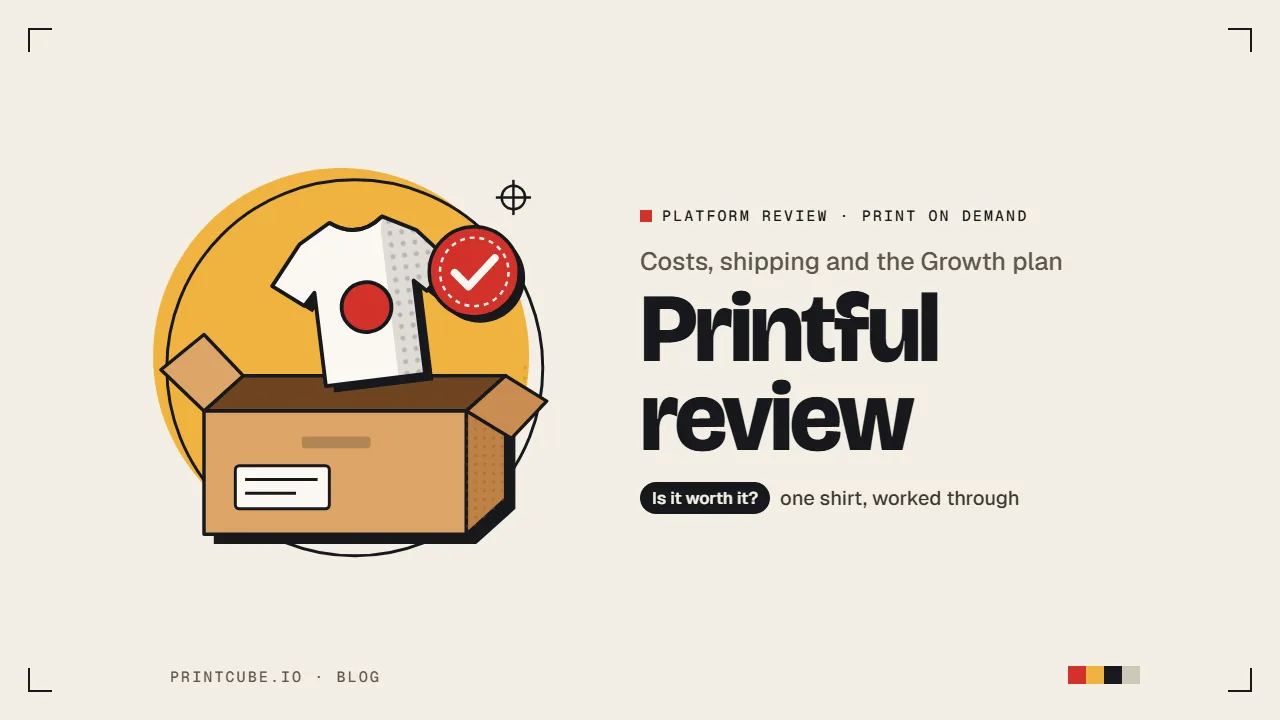

Yes, Printful is legit. It's an established print-on-demand fulfillment company that has printed and shipped orders for small sellers for years. It's also free to start: the Free plan costs $0 a month, and you don't pay anything to create products or connect a store. You pay only when a customer buys something.
So the real question is what you pay per order and how much is left for you after that. That's what this review works through, using a basic t-shirt as the example.
Printful review: is it legit, and is it really free?
Printful makes your products only after someone orders them. You upload a design, put it on a shirt or mug, and list it in your store. When a buyer checks out, Printful prints the item, packs it and ships it under your store's name. You never hold stock.
Printful has three plans:
- Free: $0 a month. You get the full catalog and integrations, and you pay per order.
- Printful Growth: $24.99 per 30-day cycle. It gives discounts on products, samples and branding. More on whether it's worth it below.
- Enterprise: priced by quote, for high-volume brands. You can ignore it for now.
Here's how the pay-per-order part works in practice. Say you list a shirt in your Etsy shop on Monday and nothing sells for two weeks. You've paid nothing. On day 15, someone orders it. Printful charges your card for the shirt and its shipping, and the buyer's payment reaches you through Etsy. Your profit is the difference between those two amounts, minus Etsy's cut.
The Printful pricing page lists the plans, but for a new store the per-order cost matters more than the plan, so start there.
What one t-shirt costs you right now
The Bella+Canvas 3001 is the shirt most sellers start with. It's soft, it fits well, and buyers recognize it. On Printful, the base price is $11.92. That covers sizes up to XL. Sizes 2XL and larger cost more, so check the size chart in the product editor before you set one price for every size.
Then add shipping. Sending one shirt to a US address costs $4.95, which brings the total to $16.87 before tax.
There's one more charge right now. From October 15, 2026 to January 17, 2027, Printful adds a $0.40 holiday surcharge to every US order. It applies on every plan and every shipping method, and it's charged once per order, not per item. During that window, one shirt shipped in the US costs you $17.27. After January 17, it drops back to $16.87.
Forty cents won't sink a sale. You should still include it when you set prices this season, because small charges add up quietly.
Pricing a shirt so something's left for you
Here's one made-up sale to show the math. It's an example to help you price, not a forecast of what you'll earn.
Say you sell the shirt on Etsy for $26 with free shipping, so the buyer pays $26 in total.
- Printful's charge: $17.27 (shirt, US shipping and holiday surcharge)
- Etsy's fees: about $2.92 in total. That's the $0.20 listing fee, the 6.5% transaction fee (about $1.69) and payment processing of roughly 3% plus $0.25 (about $1.03).
- Left for you: about $5.81
That $5.81 has to cover your design time, any ads and the odd refund. If you price the shirt at $22 to compete, you keep closer to $2 or $3. So you either price with some room or accept a thin margin on each sale. Sales vary a lot from shop to shop, and there's no guarantee your listings will sell at any price.
One habit helps: work out your landed cost and fees before you choose a price, not after. The landed cost is also the number that changes most once your buyers live outside the US.
Shipping costs if your buyers aren't in the US
Here's what Printful charges to ship t-shirts to each region. "First item" is the cost for one shirt. "Each extra item" is what each additional shirt in the same order adds.
| Region | First item | Each extra item |
|---|---|---|
| US | $4.95 | $2.20 |
| Europe | $4.99 | $1.45 |
| UK | $4.79 | $1.50 |
| Canada | $8.59 | $1.95 |
| Australia / New Zealand | $7.99 | $1.40 |
| Worldwide | $12.49 | $6.00 |
Europe and the UK cost about the same as the US, so if your buyers are in London or Berlin, the math above still holds.
Canada and Australia are where it changes. A single shirt to Toronto costs you $11.92 + $8.59 = $20.51. At the $26 price from the example, that leaves very little once Etsy takes its cut. Sending a shirt to a "worldwide" country costs $24.41 before you've earned anything.
If many of your buyers are in Canada or Australia, charge shipping separately or set regional prices. Bundles also help, because extra items are cheap to add. A second shirt to Australia adds only $1.40. You can check current rates on Printful's shipping rates and delivery times page.
How long orders take, and what to tell holiday shoppers
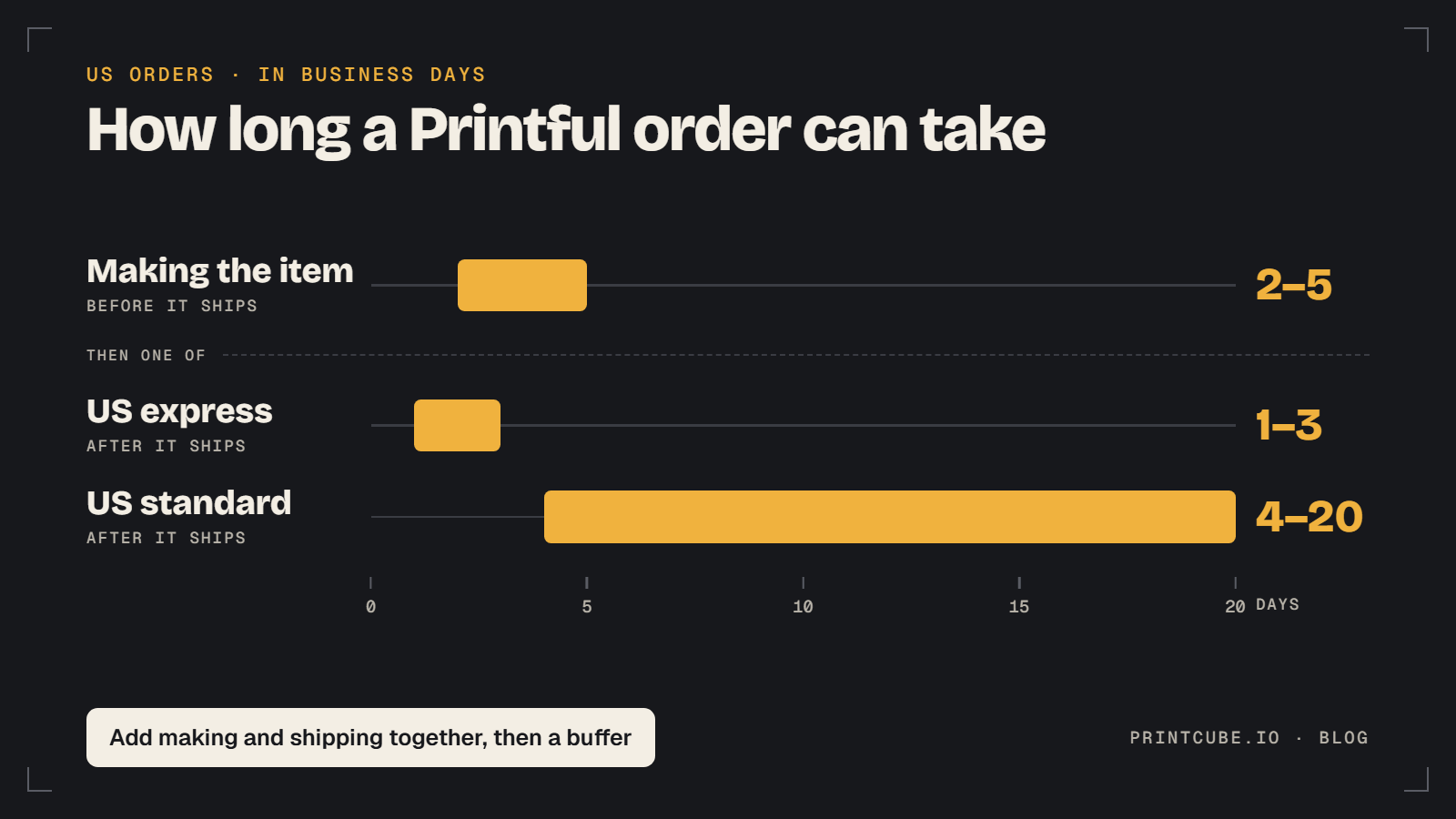
Each order goes through two stages, and Printful's shipping page and help center give a range for each. First, Printful makes the item, which usually takes 2 to 5 business days. Then the carrier delivers it:
- US standard: 4 to 20 business days
- US express: 1 to 3 business days
- Other countries: the range depends on the country, so look up your buyers' countries on the shipping page
Printful calls these estimates, not promises, and the holidays are the busiest time of year for printers and carriers.
Add up the worst case for each stage, then add a buffer. For Christmas 2026, which falls on a Friday, that gives these dates:
- US, express: order by about December 11
- US, standard shipping: order by about November 17 if you count the full 20 business days. The delivery estimate on each product's page is tighter, so check it in early December before you move this date later.
- Canada, Australia and international: count back the same way from the country's range on Printful's shipping page, and expect a date in mid-November or earlier
Put these dates in your shop banner and listing descriptions. A buyer who knows the cutoff won't leave you an angry review on December 26.
The extras that eat into your margin
Printful offers several add-ons, and each one adds to the cost of every order that uses it:
- Inside labels: your brand printed inside the neck where the tag would go
- Outside labels: a small printed label on the outside of the garment
- Extra print placements: a sleeve, back or neck print on top of the front design
- Embroidery digitization: a one-time fee to convert your design into a stitch file before it can be embroidered
- Premium images: stock art from Printful's library that you pay to use
- Pack-ins: flyers, stickers or thank-you cards in the package
Prices change, so check the current cost in the product editor before you add any of them.
At the start, I'd skip labels, pack-ins and premium images. They're nice for a brand, but buyers rarely pick a shirt because of a neck label, and every extra dollar cuts into a margin that's already thin.
Extra placements are worth it only when the design needs them. A small chest logo with a big back print is a fair reason. Adding a sleeve print just because the option is there isn't. Digitization is a one-time cost, so it's fine if you're committed to embroidery.
Is Printful Growth worth $24.99 a month?
Printful Growth has been Printful's only paid plan since January 15, 2025, when it replaced the old Business plan with the same perks. It costs $24.99 every 30 days and renews automatically. You get a 14-day free trial, and local prices are GBP 19.99, EUR 24.99, CAD 34.99 and AUD 39.99.
There's also a bonus: once your yearly sales reach USD 12,000, Growth is free for 12 months.
The discounts are capped at "up to" a percentage, and the cap depends on how the product is made:
- DTG printing (most t-shirts): up to 25%
- All-over print: up to 33%
- Home & living: up to 25%
- Embroidery: up to 9%
- Branding and extra DTG or embroidery placements: 9%
- Samples: 25% off, compared with 20% on the Free plan
"Up to" means the discount on a given product can be lower, and on the shirt in this review it is. Check the Growth price of each product you plan to sell before you decide.
When it pays for itself
Divide $24.99 by what you save per item. The Bella+Canvas 3001 doesn't get the full 25%: on Growth its base price drops from $11.92 to $9.78, so you save $2.14 per shirt. You'd need to sell about 12 shirts a month before the plan covers its own cost.
Embroidery looks very different. Printful's classic dad hat (Yupoong 6245CM) costs $14.94 embroidered and $13.76 on Growth. That's $1.18 saved per hat, so you'd need about 22 hats a month just to break even.
My advice: stay on Free until a typical month gets you past those numbers, then start the trial. Before you think about volume, though, make sure the product is good enough to sell.
Print quality, and what happens when an order arrives wrong
Printful uses four main printing methods:
- DTG (direct to garment): ink printed straight into the fabric, like a big inkjet printer for shirts. It's great for detailed, colorful designs, and the print feels soft. It looks best on cotton-heavy shirts.
- DTF (direct to film): the design is printed onto a film and then heat-pressed onto the item. Colors stay bright, even on dark or tricky fabrics, and the print sits slightly on top of the cloth.
- Embroidery: your design stitched in thread. It's durable and looks premium, but it works best with simple shapes and a few colors.
- All-over print: the design covers the whole item, seam to seam, which works well for bold patterns.
Print quality on Printful is generally consistent, and that's a big part of why its base prices are higher than some rivals'. Your design file still matters, though. A blurry PNG prints as a blurry shirt.
When something goes wrong
Every printer misprints sometimes. If an order arrives with a misprint, damage or the wrong item, report it to Printful from your dashboard as soon as you hear about it. Ask your buyer for clear photos showing the problem and the label. Once the claim is accepted, Printful will reprint the item or refund it. Printful only accepts reports filed within 30 days of the delivery date, so don't let a complaint sit for weeks.
How fast a fix arrives also depends on where the order was printed.
Where Printful prints your orders
Printful runs its own fulfillment centers in several countries and also sends some products to partner facilities. You don't usually get to choose. Printful routes each order based on the product and where the buyer lives.
This affects you in three ways:
- Consistency: an item made in one of Printful's own centers and the same item made by a partner can look slightly different. The difference is usually small, but you'll notice it if you sell matching sets.
- Speed: an order printed close to the buyer arrives sooner. That's why European and UK shipping prices are close to US prices.
- Customs: if a buyer in Europe gets a package made in Europe, they usually avoid surprise import charges. Orders that cross borders can trigger customs fees for the buyer, and buyers often blame the seller for them.
If most of your buyers are outside the US, check which products Printful can make in their region before you build your catalog around them.
Getting help when an order goes wrong
Printful handles support through its help center and through chat and email from your dashboard. The help center covers most setup and billing questions well enough that you won't need to contact anyone.
Here's a common scenario. A buyer messages you on a Friday night saying their shirt arrived with a smudge. Reply that night to say you're sorting it out. Ask for photos, then file the claim with Printful with the order number and the photos attached. You don't have to wait for anyone to pick up a phone. Just make sure the claim is complete so Printful doesn't come back asking for more information.
The more clearly you document the problem, the faster it gets resolved, and that's true at any print shop.
Connecting Printful to Shopify, Etsy and other channels
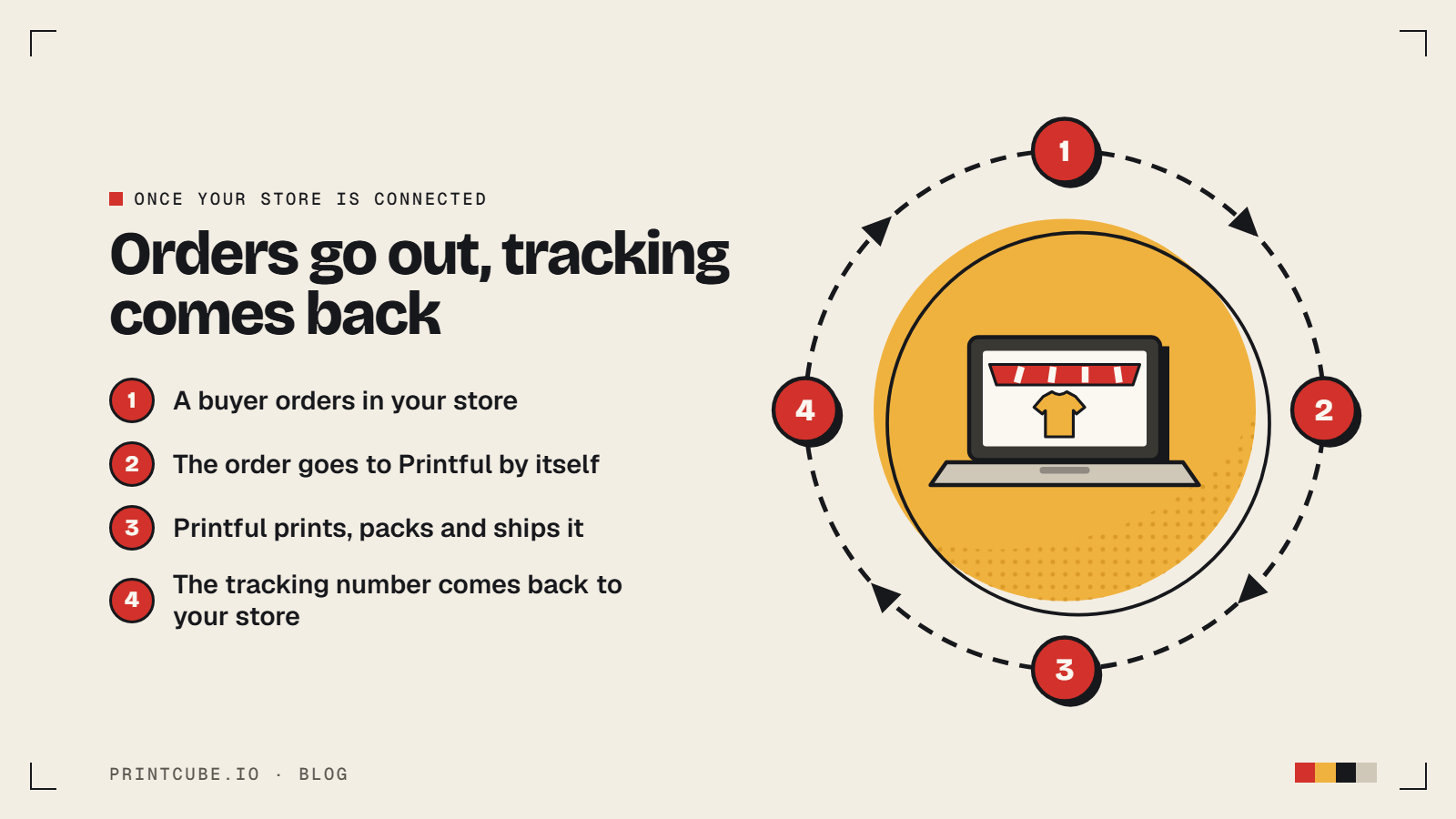
Printful connects to Shopify and Etsy, plus a long list of other platforms and marketplaces. Once your store is connected, orders go to Printful automatically and tracking numbers come back to your store.
If you don't have a store yet, Printful's Quick Stores give you a simple storefront hosted by Printful. It's a fast way to test a design before you pay for Shopify.
If you plan to sell somewhere less common, check Printful's integration list for your exact channel before you design anything. Some integrations do more than others.
Your first 30 days on Printful
Here's how I'd spend the first month:
- Week 1: order a sample. Get the exact shirt and color you plan to sell, with your design on it. Wash it twice, look at the print, and take your own listing photos with it.
- Week 2: list one product. Pick one design, set your price using the landed-cost math above, and connect your store. Don't build out a whole collection yet.
- Weeks 3 and 4: watch your real costs. Compare what Printful charged you with what you expected. Check fees, shipping and any extras you didn't plan for.
- End of the month: decide about Growth. If you're regularly selling more than about 12 DTG shirts a month, start the trial. If not, stay on Free.
If the numbers still don't work by the end of the month, try another platform.
Printful alternatives worth checking
Printify usually has lower base prices because it's a marketplace of independent print providers. You choose the provider for each product. The downside is that quality and speed depend on which provider you pick, so ordering samples matters even more there. For a side-by-side profit breakdown, see our comparison, Printful vs Printify: Which Leaves More on a $25 T-Shirt?
Gelato prints in local facilities in many countries. That makes it worth a look if many of your buyers are in Canada, Australia or other places where Printful's shipping eats into your margin.
The verdict: should you sign up for Printful?
Printful suits you if you want reliable quality, simple setup and a supplier you can trust with your first sales, and your buyers are mostly in the US, Europe or the UK. You pay more per shirt than you would elsewhere. In return, you're less likely to deal with refunds caused by poor printing.
Look elsewhere if your plan depends on very low prices, or if most of your buyers are far from Printful's printing locations.
Whichever you choose, start the same way: order one sample of the product you plan to sell and check it with your own eyes before you list anything.
FAQ
Can I cancel Printful Growth anytime?
Yes. It renews every 30 days, so cancel before the next cycle to avoid another charge. If you cancel during the 14-day trial, you won't pay at all.
Do I need a business license to start on Printful?
Printful doesn't ask for one when you sign up. Local rules on registering a business and collecting sales tax vary, so check what applies where you live once sales start coming in.
Should I order a sample before listing?
Yes. Samples are 20% off on the Free plan and 25% off on Growth. A sample lets you check the print and take real photos, and it can save you from a refund that would cost more than the sample did.
Does Printful charge me if an order is returned?
Printful makes items to order, so it doesn't accept returns when a buyer changes their mind. If you refund that buyer, the money comes from you. Misprints and damage are covered by Printful's reprint and refund process. If a package comes back because of a wrong address, you'll usually pay to ship it again.