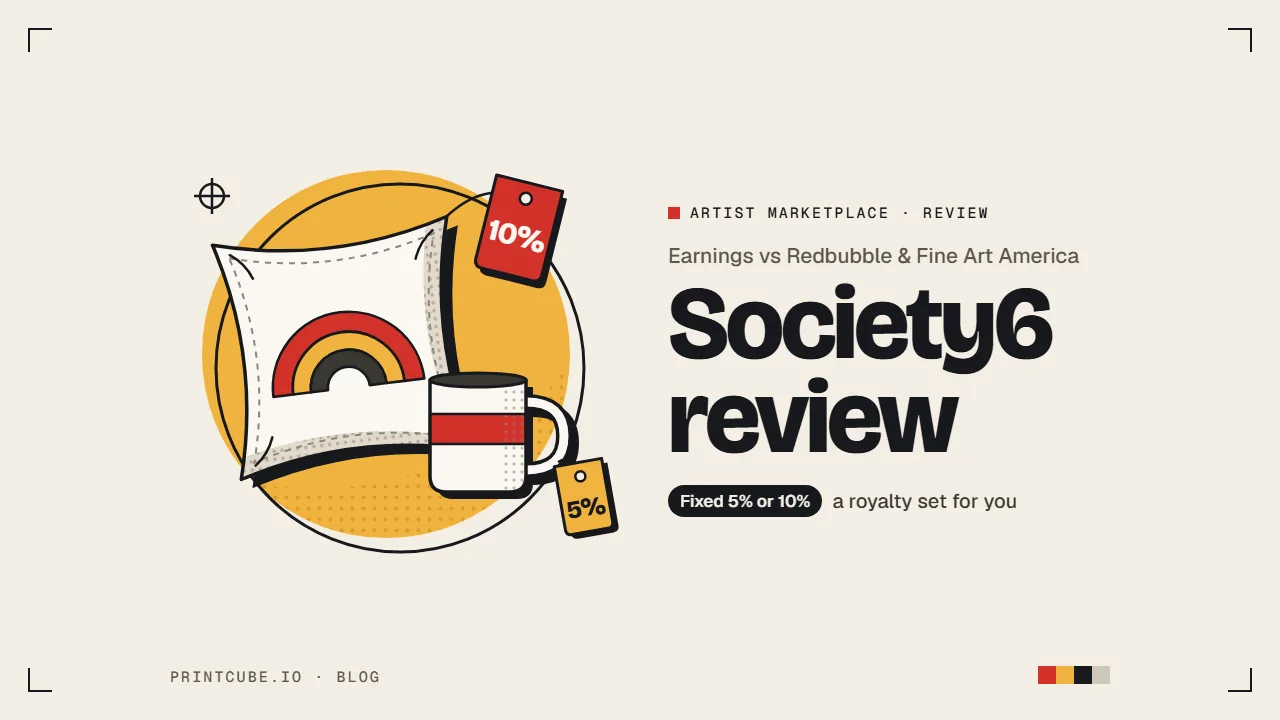

Society6 is legit. It's a real art marketplace that has been running for well over a decade. It prints, packs, ships and handles customer service for every order, and your only job is to upload designs. The money has changed, though. Since March 18, 2025, artists earn a fixed royalty of 5% or 10% that they can't adjust, which comes to roughly a dollar or two on most products. You also can't just sign up anymore. You have to apply and be accepted.
If you're deciding whether to apply, or whether to stay after years of selling there, the rest of this walks through what that deal looks like in real dollars.
Is Society6 Legit, and What Will You Earn per Sale?
Yes, it's a safe place to put your work. Customers pay Society6, Society6 makes the product, and you get a cut. You never touch inventory, deal with a printer, or answer a customer email about a dented frame.
That cut is small, and it's set for you. A 10% royalty applies to wall art and a few home decor items. Everything else pays 5%. On a typical mug you're looking at about a dollar. On an art print, a few dollars. Both numbers shrink whenever a sale is running, which is often.
So the honest framing is this. Society6 now works less like a shop where you set your prices and more like a licensing deal: they handle everything and pay you a small royalty on each item. Whether that's a good deal depends on what you want from it.
What Society6 Reviews Get Wrong Since the Pricing Change
If you've been reading older Society6 reviews, a lot of what you've picked up is out of date. Here's what changed.
You can't set your own markup anymore. Older write-ups explain how to raise your markup on art prints and framed prints to earn more. That option ended with the March 2025 pricing update. Society6 now sets standard prices across the site and a fixed percentage for each product type.
There's no paid Pro plan to buy. You'll still see pages recommending a monthly Pro membership for perks and better visibility. That isn't part of how Society6 works now, and there's no fee to sell.
Shipping no longer comes out of your earnings. For orders placed on or after March 18, 2025, shipping costs aren't deducted from what you make.
Some orders pay a flat 5%. If your design sells through trade, wholesale or a third-party marketplace such as Amazon, you earn 5% of the net sale, whatever the product is.
Society6 lays all of this out in its March 2025 update on pricing and artist earnings. Before any of these numbers matter to you, though, you have to get in.
How to Get Accepted as a Society6 Artist
Society6 is curated now, which changes how you get started.
The application
You fill out an artist application form. The most important part is a link to a professional portfolio. Society6 says outright that it can't consider applications without one. A personal website works, and so does a clean portfolio page on an art platform. A random social feed mixed with selfies and memes won't help you.
What they're looking for
The work has to be original, high-resolution and ready to print. AI-generated art and stock photos aren't accepted. Society6 also wants a clear point of view, meaning a recognizable style rather than a little of everything.
A real person on their team reviews each application, and there's no fixed timeframe. You might hear back quickly or wait a while. The Society6 page on becoming an artist has the current form and requirements.
Why good artists still get turned down
Society6 curates for a particular style and a particular customer: someone shopping for home decor and gifts with a design-forward look. Your work can be skilled and still not fit that. Say you're a strong technical artist whose portfolio is mostly fan art and photorealistic pet portraits. You'd likely struggle here, and that's no comment on your talent.
Every new design gets reviewed too
Getting accepted isn't the last gate. Each new design you upload goes through a curated review before it goes live, so plan for some lag between uploading and selling.
How Your Earnings Are Worked Out Now
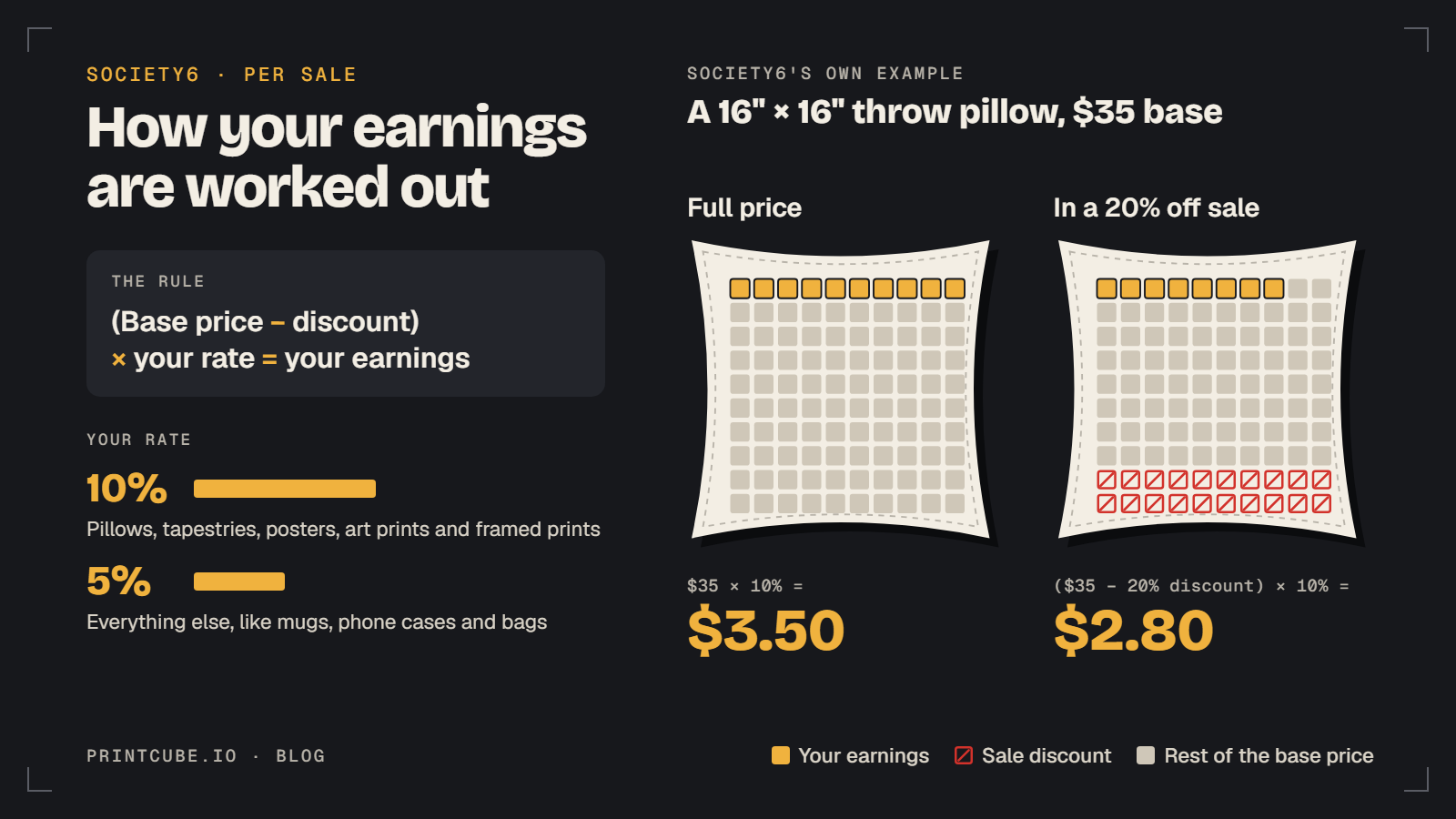
Each product has a base price that Society6 sets. It covers making the item, shipping it and handling customer service. Your royalty is a percentage of that base price.
If a customer gets a discount, it comes off the base price first, and your percentage applies to what's left. So a 20% off sale cuts your earnings by 20% too. Society6 shows this in its help page on how much you earn per sale.
Which percentage you get depends on the product:
- 10%: rectangle and square pillows, wall tapestries, posters, art prints, framed art prints and recessed framed prints
- 5%: everything else, including mugs, phone cases, apparel, bags and stationery
Wall art and pillows pay double what the rest of the catalog pays. If your style suits walls and sofas, that's where your designs earn the most.
What You'd Make on a Print, a Pillow and a Mug
Here's how it plays out on three products. The pillow is Society6's own example. The print and mug base prices are round examples to make the math easy, since Society6 shows shoppers the retail price rather than the base, so check the real ones in your dashboard.
An art print with a $40 base price. At 10%, you earn $4.00. Say Society6 runs a 20% off wall art sale and someone buys it then. The base drops to $32, and you earn $3.20.
A 16" × 16" throw pillow with a $35 base price. At 10%, that's $3.50. In a 20% off sale, it's $2.80.
A mug with a $20 base price. At 5%, you make $1.00. During a 30% off kitchen and dining sale, the base becomes $14 and you make $0.70.
Society6 runs sitewide and category sales often, and a lot of buyers wait for them. So in practice, plenty of your sales will happen at the discounted rate. If you're working out whether Society6 is worth your time, use the sale numbers, not the full-price ones. Selling 20 mugs in a month during promotions might come to around $14, while 20 prints might come to around $64.
How and When Society6 Pays You
Society6 pays artists through Trolley, its payment platform, so every artist needs a Trolley account. US artists can be paid by direct bank transfer, and PayPal is still offered through Trolley. Payments go out between the first and third business day of each month. A sale stays pending until 30 days after the order ships, so an art print that ships on January 15 is paid between March 1 and 3.
A few things keep payouts from stalling:
- Set up your Trolley account and choose your payment method as soon as you're accepted.
- Submit your tax form (W-9 or W-8) in Trolley. Society6 requires it before it can pay you.
- Check the payment section of your dashboard after your first few sales so you know when to expect money. Don't rely on what older reviews say about dates.
Because each sale pays little, it can take a while before a payout feels worth noticing. That's normal for this model.
Product Quality and What Buyers Complain About
Most buyers get a well-made product, and Society6's home decor and wall art have a good reputation for print quality. Still, if you read customer feedback, the same complaints come up again and again:
- Shipping delays, especially around the holidays or with items that ship from several places
- Print or color issues, such as colors that look darker or duller than on screen, slightly off cropping, or occasional defects
- Slow or frustrating support when something goes wrong with a return or replacement
You don't handle any of these, but they still affect you. A buyer whose pillow arrives looking muddy won't come back for your next design. A wave of returns on a product can also make it less appealing to promote.
Before you push a design hard, order a sample of it on the product you care about most. You'll see how your colors print, whether fine lines hold up, and how the item feels in your hands. If your palette has lots of deep blues or subtle gradients, this matters even more, since those are often where screen and print differ. A sample also gives you your own product photos for social media.
Will Society6 Bring You Buyers?
Some, yes. Society6 has steady traffic from shoppers looking for art-forward home decor, and being on a curated marketplace means you're not competing with millions of low-effort uploads. That's a real advantage over more open platforms.
Don't expect the marketplace to do all the work, though. New artists usually see few sales from search alone at first, and the artists who do best tend to send their own followers there through Instagram, a newsletter or their portfolio site. Treat Society6 as one channel that brings in some buyers, not a stream of orders that arrives on its own.
Why your design might not show up in search
If you can't find your work, there's usually a reason:
- It's still pending review. New designs aren't public until Society6's team approves them.
- It was declined. It didn't fit their curation, or there was a quality issue with the file.
- It was removed. Society6 takes down designs that infringe copyright, trademark or publicity rights. That covers anything using brand logos, characters, celebrity likenesses, song lyrics, or phrases someone else has trademarked.
Ownership problems are worth taking seriously. Repeated takedowns can put your whole account at risk, not just one design.
Society6 vs Redbubble vs Fine Art America
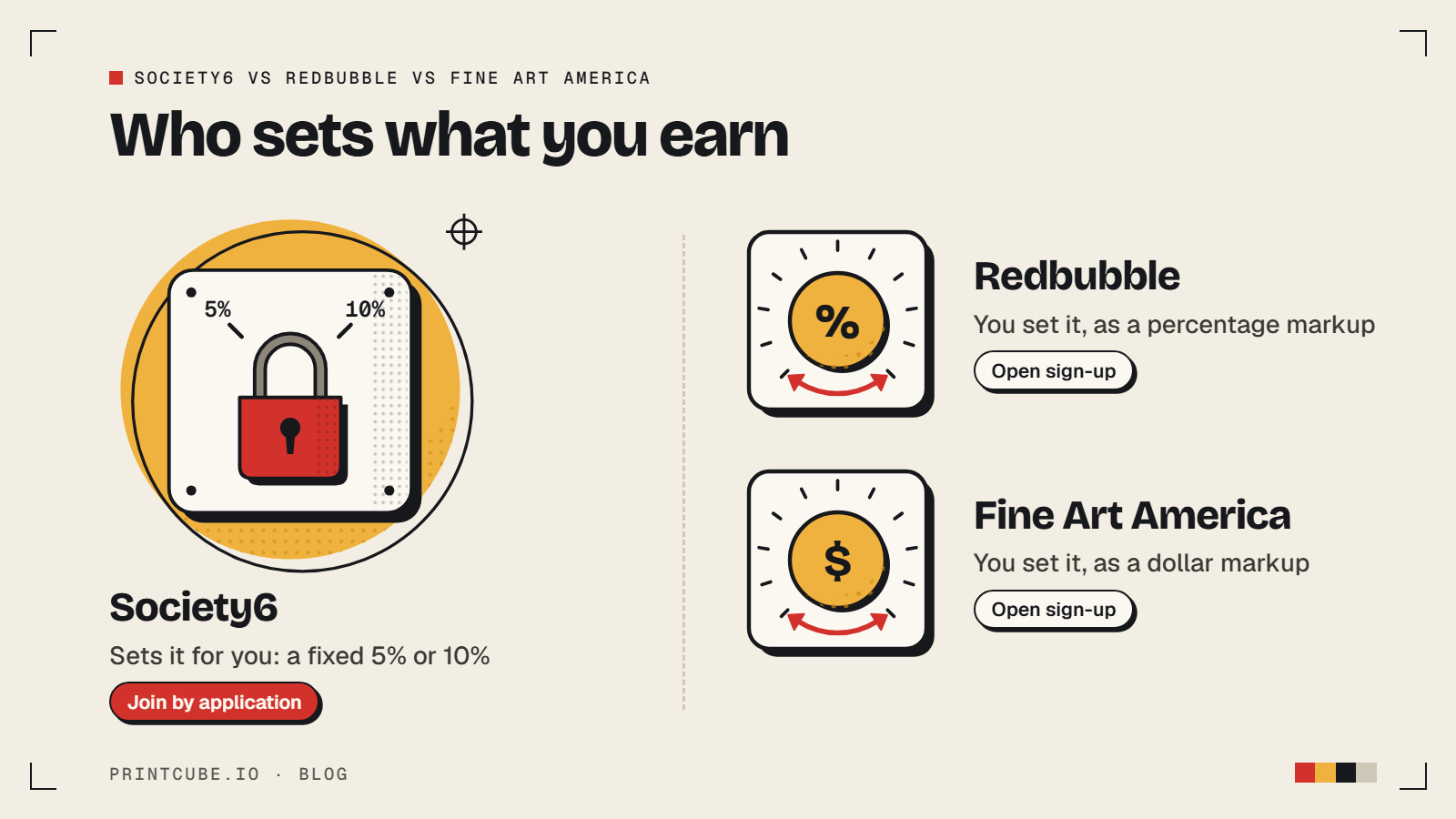
All three print and ship your designs for you, but they treat artists very differently.
| Society6 | Redbubble | Fine Art America | |
|---|---|---|---|
| Who can join | Application only, portfolio required | Open sign-up | Open sign-up |
| Who sets your earnings | Society6 (fixed 5% or 10%) | You, as a percentage markup | You, as a dollar markup |
| Pricing control during sales | None, discounts cut your royalty directly | You choose your markup level | You choose your markup amount |
| Account fees | No fee to sell | Free to join; a platform fee set by your account tier comes out of earnings | Free (25 images) or Premium at $30 a year |
| Best product fit | Home decor, wall art, pillows | Stickers, apparel, graphic designs | Framed wall art, canvas, photography |
The biggest difference is control. On Redbubble and Fine Art America, you decide how much you make on top of the base cost. If you want to earn $15 on a large framed print, you can set that. On Society6, the number is set for you.
Redbubble is the easier place to start if your work leans toward stickers, T-shirts and graphic or humorous designs. Fine Art America suits painters and photographers who sell larger, pricier wall art and want to set a meaningful markup on each piece.
Pros, Cons and Who Society6 Suits
The good:
- Legit, long-running and fully handled: production, shipping, returns and support
- A curated marketplace, so your work sits among other quality art
- No fees to sell, and shipping is no longer taken out of your cut
- Strong home decor and wall art catalog that suits illustration and pattern work
The not-so-good:
- A small royalty you can't change
- Frequent sales shrink that royalty further
- You have to apply, and you may be declined even with strong work
- Every new design waits for review before it goes live
- Buyer complaints about shipping and color can reflect on your designs
Society6 suits illustrators, surface pattern designers and artists with a clear, decor-friendly style who want their work on a polished marketplace and are happy to treat each sale as a small royalty. It's especially good if you already have an audience you can point there.
It's a weaker fit if you want to set your own prices, sell high-end wall art at a real margin, or make most of your money from apparel and stickers. You'd likely be better off elsewhere in those cases.
Verdict: Should You Apply or Stay?
If you're thinking of applying: go ahead if your portfolio has a consistent, design-forward style that would look at home on a sofa cushion or a gallery wall. Applying is free, and getting accepted gives you a curated storefront that takes no effort to run. Just go in expecting a dollar or two per sale rather than a meaningful income from Society6 alone.
If you've sold there for years and watched your earnings drop: you're not imagining it. The fixed royalty and frequent discounts mean the same sales volume now pays less than it did when you set your own markup on wall art. There's no reason to delete your shop, since it costs nothing to keep. But it makes sense to put your best wall art somewhere you control the price, such as Fine Art America or your own store, and to send your own followers there first.
My overall take: Society6 is worth having as one channel, not as your main one. It gives your work a nice home and some passive exposure, while your pricing and your real margins live on a platform you control.
FAQ
Can I still set my own prices on Society6?
No. Since March 18, 2025, Society6 sets standard prices and fixed royalty rates: 10% on pillows, tapestries, posters, art prints and framed prints, and 5% on everything else.
Do Society6 sales and discounts lower what I earn?
Yes. Discounts come off the base price before your royalty is calculated, so a 20% off sale reduces your earnings on that item by 20%.
Can I sell the same designs on Redbubble and Fine Art America too?
Yes, as long as the work is yours. Plenty of artists list the same designs on several platforms. Just read each platform's terms in case its exclusivity rules change.
Why was my Society6 application or design declined?
Usually it's about fit rather than skill. Society6 curates for a specific style and customer, and it rejects AI art, stock images, low-resolution files and anything that uses someone else's copyright or trademark.
Does Society6 charge artists any fees?
There's no fee to join or sell, and shipping isn't deducted from your earnings on orders placed from March 18, 2025 onward. The only real cost is the small royalty rate itself.